When Borders Disappear from the Sky
Low-earth orbit satellite communications is not simply about spreading technology. It is a reshaping of sovereignty over who gets to turn connectivity on and off. The rest of the world is already fighting over this question.
AI Summary
Low-earth orbit satellite communications has shifted the global debate from speed to control — specifically, which government or corporation holds the power to switch a nation's network on or off. While South Korea frames the issue primarily as a consumer technology story, Europe and the United States have long recast it as a matter of strategic autonomy and concentrated power. For Busan, South Korea's maritime hub, the stakes are already concrete: the question of which foreign-operated satellite network carries ships' location, cargo, and navigation data is ultimately one of maritime data sovereignty, not household broadband pricing.
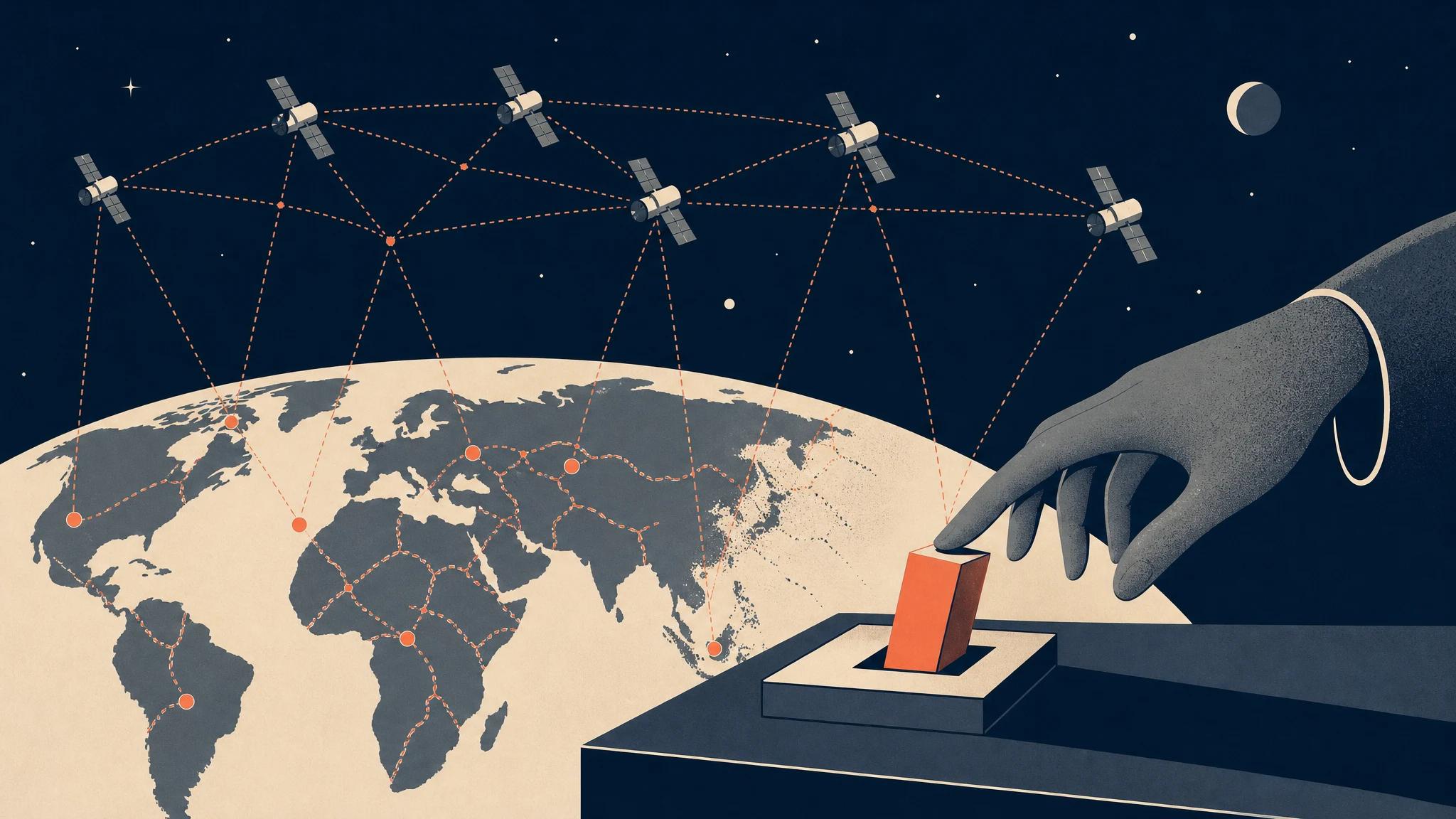
On the Ukrainian front, there was a moment when a single communications system suddenly went dark. No missile had struck; no cable had been cut. Reports emerged that a private company had decided to restrict satellite service in a specific area, destabilizing one axis of military operations. Someone, it turned out, had been sitting at a desk in the middle of a war, fiddling with a switch. The question this scene raised was not about weapons. It was about the fact that the authority to turn the sky's communications network on and off belongs not to any government, but to a single corporation.
South Korea Reads This as 'New Technology'
When the same news arrives in South Korea, it is generally consumed like this: when is Starlink coming to Korea, how expensive will it be, apparently internet gets faster on planes and ships. It gets translated into questions of connection quality, speed, and price.
That is only half the reading. Overseas, the debate over low-earth orbit satellite communications moved long ago from a speed race to a race for control. British commentators call it the "splinternet of the skies." On the ground, national governments could exercise some jurisdiction over internet infrastructure through physical chokepoints — cables, internet exchange points, data centers. But a network that has moved to the sky bypasses those chokepoints. When user terminals communicate directly with satellites, a country's telecommunications regulator has no real means of touching signals passing over its own territory.
While South Korea reads this as a product-launch timeline, the real substance of the debate lies elsewhere.
The Invisible Structure: The De-nationalization of Connectivity
In the age of terrestrial networks, communications sovereignty was straightforward. Base stations and fiber-optic cables within national borders were subject to that country's laws, and governments could, at the critical moment, block networks, conduct surveillance, or adjust traffic priority. For authoritarian regimes it was a tool of censorship — but simultaneously a safety valve for any government in an emergency.
Low-earth orbit satellites undermine this premise. When a signal descends directly from an overhead satellite to a palm-sized antenna, connectivity skips the intermediate layer called the state. This could be called an expansion of freedom — as the world cheered when Iranian protesters broke through blockades and connected to the outside world. But flip the same structure, and it means that a foreign company's terms of service and a foreign government's diplomatic leverage come to govern the connectivity of your own citizens.
Overseas discourse confronts this duality head-on. In the United States, the fact that a single private company has bundled satellite internet, launch vehicles, electric cars, and social media under one person's control is seen as a problem of power concentration. The European Union's response was different. The reason it is pushing forward with its own satellite constellation project, IRIS², is not a lack of speed. It concluded that wholly depending on outside companies for communications infrastructure amounts to a loss of strategic autonomy. Europe is already framing this not in the language of industrial policy, but in the language of security and sovereignty.
South Korea Still Calls It by a Different Name
Here the time lag between South Korea and the rest of the world becomes visible. We handle this issue somewhere between 'household communications costs' and 'the next growth engine after 5G.' There is hope that nurturing satellite communications well could create a new industry, but the question of who holds the authority to shut down that network is barely audible. The question itself has not yet been imported.
Counterarguments are possible. South Korea's terrestrial network is so dense that satellite communications are not an urgent need, and therefore there is no rush to import this debate. That has merit. In urban areas, Starlink is merely an expensive supplement. But this counterargument leaves out half the territory: Korea's sea.
Ships departing from Busan's waters enter a terrestrial-network blind spot the moment they leave the coast. Communications for deep-sea fishing vessels, container ships, and offshore platforms have long been bound to expensive geostationary satellites, and now low-earth orbit satellites are rapidly filling that void. Busan is a world-class transshipment port, a city dense with shipbuilding, marine equipment, and maritime industries. Which satellite network a ship connects to is not simply a matter of convenience. It is a question of which operator's servers carry that ship's location data, cargo information, and navigation patterns. Should the digital nervous system of the maritime industry be handed wholesale to foreign companies? This is not a question of communications costs — it is a question of maritime data sovereignty. While South Korea sees satellite communications only through the lens of household rate plans, the sector most immediately affected is Busan's maritime industry.
What Is Imported Late Is the Question
In an era when connectivity crosses borders, the real danger is not being slow to adopt technology. Technology can be brought in for a price. What is truly hard to recover once lost is the interpretive framework. When Europe began to frame this issue in the language of sovereignty, an answer took shape: a homegrown constellation. When the United States began to frame it in the language of power concentration, regulatory debate began. The side that first holds the question determines the form of the answer.
What South Korea imports late is not satellites or antennas. Sometimes it is the question itself. Who turns the sky's communications network on and off — and how much of that authority remains in our hands? If we receive this question only after others have already settled it, we are not choosing answers; we are translating answers that others have made. Interpretive sovereignty is lost before technological sovereignty.
This article was automatically translated from the Korean original by AI. For the authoritative version, read it in Korean.
한국어 원문 읽기 →