The Browser Swallows the OS
A browser with an AI agent inside is no longer a window for displaying the web. It is a new operating system that absorbs apps, search, and payments whole. The next seat of platform power will open from there. What layer will Korea's native portals and app ecosystem choose to stand on?
AI Summary
AI agents embedded in browsers are transforming them from passive display windows into active operating systems that execute searches, comparisons, and payments autonomously on behalf of users. This structural shift threatens to demote existing apps and portals to screenless backend APIs, with routing and settlement power consolidating at the agent layer. For Korea, the decisive strategic opportunity lies not in defending app and search market share but in owning the payment and identity authentication infrastructure that every automated agent transaction must pass through.
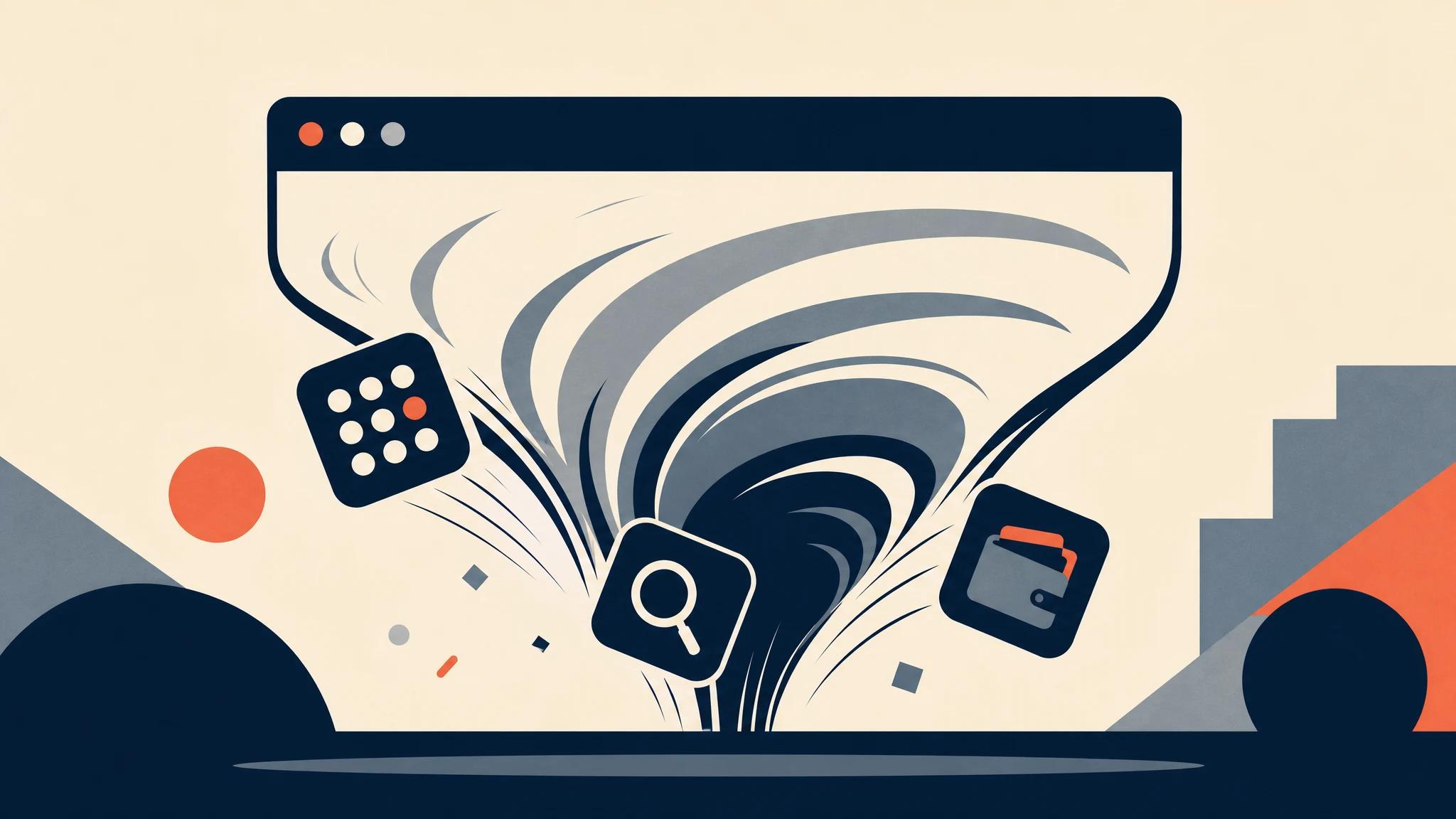
People see browsers as tools. A window for opening tabs, typing addresses, and viewing screens. Whether it's Chrome or Safari, what you do inside is what matters — the browser itself is treated as transparent glass. This perspective is causing people to miss the biggest change happening right now.
As AI agents move inside the browser, the glass is no longer transparent. When a user says, 'Book the cheapest KTX to Busan next week and find me a place to stay,' the agent browses sites directly, searches, compares, and clicks the payment button. The person only sees the result. At that moment, the browser is no longer a window — it becomes an actor. And software that acts on its own is what we normally call an operating system.
Convergence Has Always Shifted the Seat of Power
The industry map has repeatedly changed whenever one technology merged with another. When the mobile phone combined with the internet, a touchscreen, and an app distribution channel, the iPhone became not a phone but a platform. Customer relationships once held by carriers shifted to Apple's and Google's app stores. Carriers were relegated to pipe operators — laying networks and collecting fees.
Search followed the same path. Google started as an indexing tool that showed links, but by combining with ad auctions it became both the gateway to web traffic and the settlement hub for digital advertising. The key is not the technology itself but the junction of combination. Search plus auction; phone plus app store. Power always emerges at the seam where two technologies meet. Whoever controls that seam settles the revenue above and turns what's below into a pipe.
What Is the Browser Combining With?
The technologies an AI-embedded browser is combining with are not just one or two. First, there is agent reasoning: decomposing a user's vague intent into steps and forming an execution plan. Next comes computer vision and screen manipulation capability — reading screens, clicking, and entering data just like a human. Last — and this is decisive — is payments and identity. For an agent to complete a payment, card information and personal authentication must be integrated at the browser layer.
When these three combinations occur simultaneously, the structure is inverted. Right now, users open the Coupang app, search on Naver, and pay with Toss. Each app meets the user directly. Once an agent browser enters the picture, the user communicates only with the agent, and apps retreat to components the agent calls. Apps that once had screens are effectively demoted to screenless backend APIs.
This is where new economic actors emerge: a settlement layer for each agent execution, a routing layer that decides which apps to call, and a layer that charges commissions on those calls. The position once occupied by app stores taking 30 percent is now taken by the agent. By deciding which services to connect users to, it levies a new toll. Just as search rankings did, the agent's call rankings become the next seat of power.
Two Paths for the Korean Ecosystem
There is a counterargument: Korea has strong native platforms in Naver and Kakao, and user habits are entrenched, so global agent browsers won't easily break in. That's only half right. Native players held on to search habits, but the OS layer — Android — and app distribution channels ultimately went to Google. Even if you defend the upper-layer habits, losing the underlying operating system means ceding settlement power. The agent browser is targeting precisely that lower layer.
So the position Korea should secure is not competition at the upper service layer, but the seam of combination. Korea is the world's most densely wired market for real-name authentication and simple payments. Toss, Naver Pay, and Kakao Pay already hold the payment and identity layer. For an agent to automate all the way through to payment, it must pass through exactly this layer. What today looks like a minor point — 'agent payment authentication standards' — could in a few years become the infrastructure through which every automated transaction passes.
There is also a path for Naver. Rather than playing defense to protect search results, the better move is to be the first to open its entire suite of services in a form that agents can call easily. In the agent era, the losers are apps that never get called, and the winners are the components that get called most cleanly. The same applies to fintech and commerce startups in Busan. Rather than building out a flashy app interface, what survives is having a structured interface that agents can call with precision.
The future doesn't come from a single browser. It comes from the seams where the browser meets agents, meets payments, and meets identity. Power always pools at the places where technologies connect. What Korea needs to examine right now is not the flashiest app, but the junctions of combination that no one is paying attention to.
This article was automatically translated from the Korean original by AI. For the authoritative version, read it in Korean.
한국어 원문 읽기 →