The Data Center Moves to the Neighborhood
The decentralization of edge data centers is not a product announcement — it is a signal that the geography of computing is being redrawn. The competition to attract investment to Korea's southeastern region is not a battle over rents; it is a positioning game that will determine the next cost structure for Korean businesses.
AI Summary
Edge data centers are moving compute from centralized campuses to distributed neighborhood-level nodes, with benchmarks showing per-token inference costs cut by more than half while latency holds below 500 milliseconds. This shift is redrawing the geography of AI infrastructure, and Busan stands at a potential gateway to Southeast Asia through converging undersea cable landings. Whether Korea captures toll-collecting, standard-setting roles in distributed inference — or remains a chip supplier and cable passthrough — will be decided in the next few years.
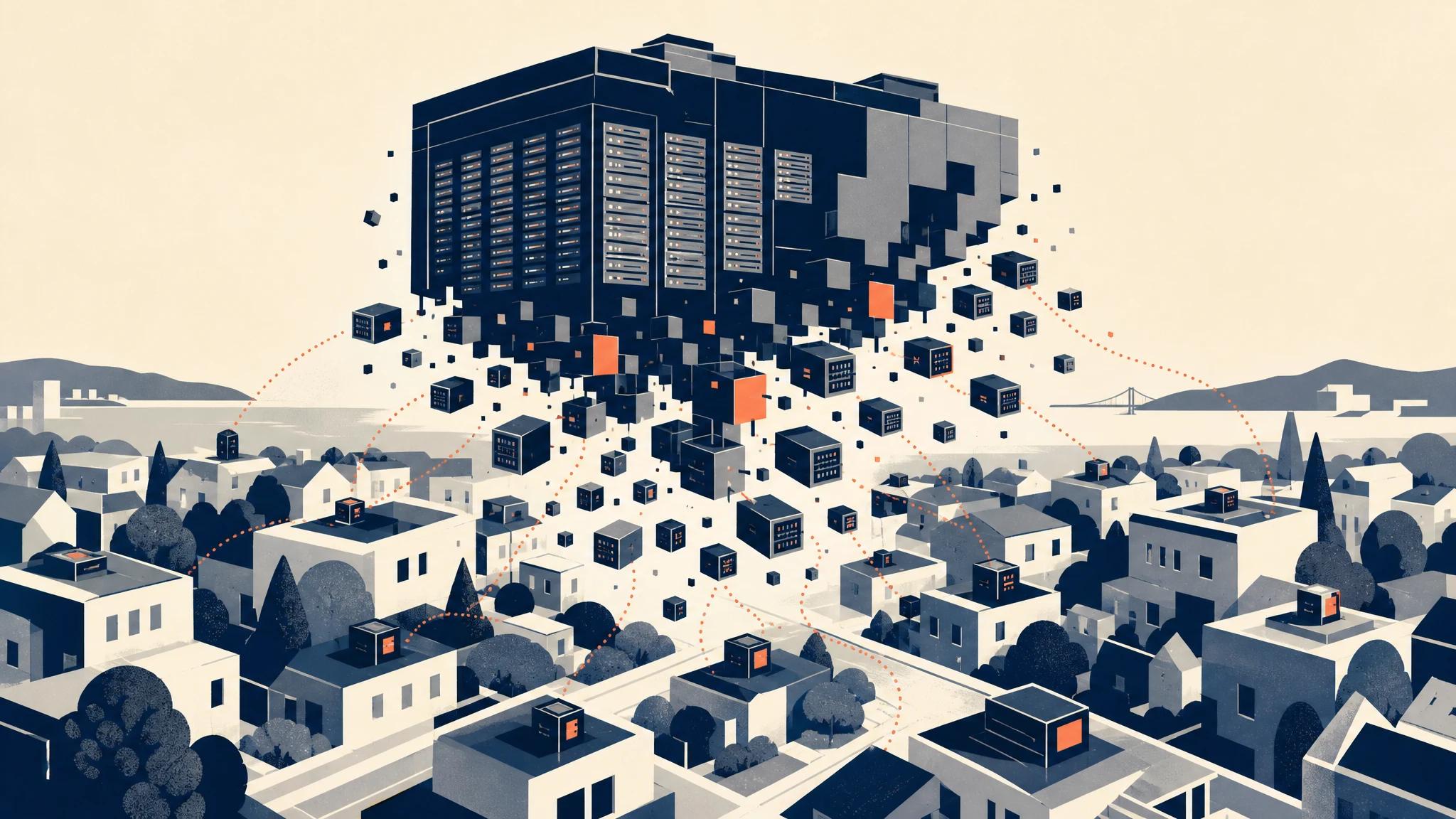
One Cluster Split Across Four Sites
In March of this year, Crusoe launched an edge zone that bundles modular data centers. The company claimed it delivers first-token latency 9.9 times faster than standard configurations and five times higher throughput. Around the same time, at GTC 2026, NVIDIA unveiled an AI grid architecture that transforms telecommunications networks themselves into an inference platform. In a benchmark conducted with Comcast, distributing a single centralized cluster across four sites reduced per-token costs by 52.8 percent under normal conditions and 76.1 percent during traffic spikes. Latency stayed below 500 milliseconds even at P99 traffic surges.
On the surface, it looks like product bragging — faster and cheaper. But reading it as product news means missing the entire point.
The Real Story Behind 'Faster'
The real story is not speed — it is location. Over the past three years, capital flowed toward building massive training clusters in a single place: single campuses of hundreds of megawatts, tens of thousands of GPUs planted next to power grids. But inference operates under different laws of physics than training. The moment a user feels the difference between 100 milliseconds and 30 milliseconds, distance becomes quality. Even light takes time to make a round trip from Seoul to Virginia. That is why inference racks must come down to where people live.
This is where the geography of data centers flips — from centralization to regional distribution, from one enormous building to hundreds of small nodes embedded in every neighborhood. A company called Span has even piloted a scheme to embed distributed computing in 100 newly built homes: 1,600 GPUs and 1.25 megawatts split across individual houses. The data center is moving from the industrial estate to the living room.
The counterargument is obvious: distribution is inefficient. The logic goes that concentration is what unlocks economies of scale in cooling, power purchasing, and operations staffing. For training, that is correct. But inference is a workload that runs frequently and in small pieces. In an era when small language models (SLMs) are running in kiosks and on factory floors, 30 milliseconds next to the user generates more money than the efficiency of a single consolidated cluster. The very fact that NVIDIA is promoting telco edge over the large clusters that are the core of its own revenue is itself a signal pointing to where the next battleground lies.
Capital Is Buying the Layer
So we need to watch where the money goes. The reason big tech is partnering with telecommunications companies is simple: the real estate and power needed to deploy inference nodes are already in the hands of telecoms — central offices, metro hubs, base stations. NVIDIA sells the control plane that ties these scattered nodes into a single programmable fabric. Telecoms supply the real estate; NVIDIA holds the standard. Do you see who is capturing the layer? Whoever controls the chip and orchestration layer ultimately collects the same toll from every distributed node that runs on top of it.
This is the capital shift unfolding in the United States — from the enormous physical asset of training campuses to the thinner but far more valuable position of owning the standard that ties distributed inference together.
Is Korea a Supplier or a Customer?
This is where we must examine Korea's position. Korea stands in three roles in this game simultaneously: supplier, customer, and — possibly — standard-setter.
On the supplier side, Korea is strong. As distributed inference grows, demand for HBM deepens. SK Hynix has already sold out its entire 2026 allocation, and Samsung is expanding next year's production capacity by roughly 50 percent. HBM3E prices have risen by nearly 20 percent. At the chip layer, Korea is an unambiguous supplier.
The problem lies in the other two roles. The distributed inference standard — the control plane of the AI grid — belongs to NVIDIA. Korean companies become customers paying tolls on top of it. The standard-setter seat is vacant, and no one has claimed it yet.
Looking at Busan, the coordinates of opportunity come into focus. While Seoul holds roughly half of Korea's data center capacity, Busan is growing at the fastest rate — 27.55 percent annually through 2031. Submarine cables such as JAKO, BridgeOne, and SJC2 are landing in Busan and Ulsan. This makes Busan the gateway to Southeast Asia and Japan. If 30 milliseconds near the user equals money in the distributed inference era, then Busan becomes the Korean node closest to Southeast Asian users.
The practical stakes of competing to attract investment to the southeastern region are therefore not simply tax revenue or construction jobs. If Busan remains only a cable landing station, it collects nothing but rent. But if Korea designs even one layer of the inference standard at the point where those cables converge, Korea captures a portion of the toll on every token flowing toward Southeast Asia.
The Cost of Watching and Waiting
This news from Silicon Valley is not someone else's story. The moment distributed inference cuts per-token costs below half, the profit-and-loss calculation of every Korean company competing on that cost structure is reset. When a competitor with cheaper inference offers the same service at a lower price, watching from the sidelines is, in effect, accepting a cost disadvantage.
Delay the decision now, and Busan remains a cable passthrough. A passthrough does not collect tolls. The toll-collecting position belongs to whoever controls even a single line of the standard. These next few years — as data centers descend to the neighborhood — will determine whether Korea stays a supplier or gets to design even a corner of the standard.
This article was automatically translated from the Korean original by AI. For the authoritative version, read it in Korean.
한국어 원문 읽기 →