The Commons Are Being Enclosed
Overseas, the closure of AI weights is read as enclosure. In Korea, it is still read as a license change notice. What we are slow to import is not the model — it is the question.
AI Summary
The article argues that the incremental restriction of AI model licenses — often dismissed in Korea as routine policy updates — mirrors the historical enclosure movement, in which common land was legally privatized at the expense of those who depended on it. While the U.S. and Europe are already debating the public-interest implications of 'open-weight' models that withhold training data and compute, Korea risks missing the deeper question of what openness actually guarantees. Without a vocabulary to distinguish meaningful openness from the mere release of weights, Korean developers and companies may celebrate a form of 'open' that is, by global standards, already effectively closed.
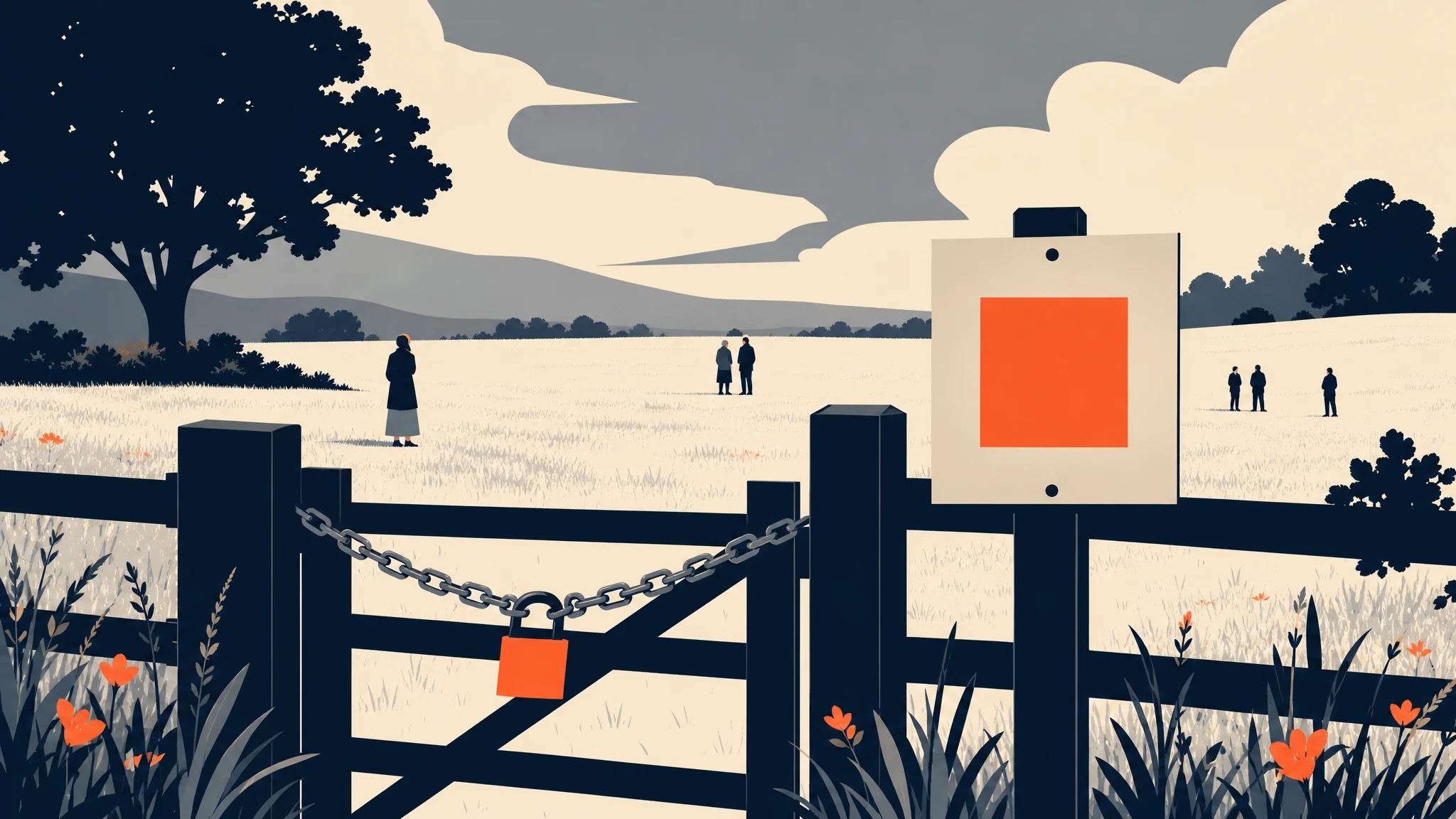
Over the past few years, a company called its model 'open,' then one day changed a single line in its terms of service. The weights are still downloadable, but companies above a certain revenue threshold cannot use them, using them to train competing models is prohibited, and redistribution comes with conditions. The code is the same; the rights are different.
Foreign commentators did not treat this as a technology news story. They reached for a word from 16th-century England: enclosure — the process by which common land was fenced off and privatized.
In Korea, the news typically arrives like this: 'Model XX changes license policy.' A thread appears in a developer community, someone summarizes it as 'be careful with commercial use now,' and the matter is filed away as a terms-of-service update.
That is the first misreading. A license change is a consequence, not the event itself.
The invisible structure is this: the term 'open source' originally bundled two promises — the ability to see the source, and the ability to do anything with it. In the software era, these two were nearly inseparable. In AI, they have split apart.
Even when weights are released, training data remains private. Even when you receive the model, the billions of dollars of compute that built it do not come with it. So what 'open' actually guarantees keeps shrinking. Something you can receive but cannot reproduce — that is less a commons and more a showroom.
This is why foreign discourse chose the word enclosure. England's enclosure was not theft. It was entirely legal. Parliament passed the laws; the fences were legitimate. But land that had belonged to everyone became someone's private asset, and those who had grazed their livestock there were left with nowhere to go. A redistribution that happened without violence. The closure of AI weights resembles exactly this texture of legality.
In the United States, this debate has already been translated into political language. One side argues that the more powerful a model, the more it should be closed, citing safety — the prevention of misuse and proliferation. The other side suspects that 'safety' is a coat legitimizing market dominance. Europe is different again: in drafting its AI Act, it fought a definitional battle over how far to extend the 'open-source exception' and what should truly count as open. Over there, this is not a terms-of-service conversation but a three-way dispute entangling power, safety, and the public good.
Here is one counterargument: 'As long as we can still download it, isn't that enough? Isn't it a hundred times better than a closed API?' True. And precisely that sense of relief is what legitimizes the fence. The essence of enclosure is that rights quietly transferred while people were comforted by the thought, 'at least we can still graze.' Access rights and ownership rights operate on different planes. When we lose the latter while reassuring ourselves with the former, the deal is already done.
The danger when Korea is slow to grasp this is not simply an information gap. Our open-model camp is currently standing at a promising starting line. Domestically developed models are emerging, and some are releasing their weights. The problem arises when this camp stops at the pride of saying 'we too are making things open.'
Without a vocabulary for parsing the degree and type of openness, we end up calling the weakest possible form of 'open' by the name of open and feeling satisfied. A model that releases only its weights while keeping training data, training code, and the path to reproduction entirely closed — something that, by global standards, is essentially closed — is something we could congratulate ourselves on as open.
Say a startup in Busan builds a product on a domestic open model. One day, that model's terms of service change. The company that can say 'this is enclosure' and the company that shrugs and says 'the license changed again' will respond at completely different speeds. The word is the defense line.
In the end, this is a question of interpretive sovereignty. Whether you read the same event as a terms-of-service update or as the privatization of a commons is not a matter of translation accuracy — it is a difference in negotiating power. The other side is already naming what is being taken from them and fighting back. If we receive that as an update notice, we are applauding without even realizing we are being dispossessed.
What Korea is slow to import is not technology. Sometimes we are slow to import the question itself. In the sentence 'open source is closing,' what arrives late is not the model's terms of service — it is the question: 'What does it even mean to be open?'
This article was automatically translated from the Korean original by AI. For the authoritative version, read it in Korean.
한국어 원문 읽기 →