Who Writes the Code?
In an era when AI agents churn out code, the developer's job is shifting from 'writing' to 'judging.' Which layer of Korea's SI and outsourcing pyramid will this shift collapse first?
AI Summary
Code-generating AI tools — from GitHub Copilot and Claude Code to Cursor and Devin — are not eliminating developers but restructuring their role from writing to judgment, verification, and architecture, following the same historical pattern as compilers and spreadsheets. In Korea, the multi-tier SI subcontracting industry faces acute pressure at its lowest layer, where low-cost, specification-driven coding work is precisely what AI agents handle best. The country's path forward lies in moving up the value chain toward formal verification, security auditing, and domain-specific system design — areas that remain automation-resistant and command premium trust.
Not the End of Coding, but a Shift in Where Coding Lives
There are two camps when it comes to AI coding tools. One is frightened that developers will disappear; the other dismisses these tools as glorified autocomplete. Yet both rest on the same misunderstanding: they treat coding as 'the act of pressing keys on a keyboard.'
What is actually changing is not the hands that type, but the center of gravity for judgment. As GitHub Copilot evolved beyond autocomplete into Copilot Workspace — and then into an agent that opens pull requests from issues — the part of human work involving 'the writing' has moved down to machines, while 'deciding what to write, why, and how' has moved up. Anthropic's Claude Code, Cursor, and Devin-class tools all point in the same direction. Developers who were authors are becoming verifiers and architects.
Reading this shift as merely a performance upgrade for a single tool misses the point. Code-generating AI does not operate in isolation. It reshapes industries only at the junctions where it connects with other technologies.
Convergence Has Always Pushed 'Writing Work' Downward
History shows that technological convergence has always moved one layer of labor down to machines and lifted humans up one layer. Compilers did exactly this. In the 1950s, programmers wrote in machine code by hand; when assembly language and FORTRAN arrived, there was pushback — 'real programmers don't use such abstractions.' The result was the opposite. Once hand-writing machine code was handed off to compilers, more people tackled more complex problems, and the software industry itself exploded.
Accounting followed the same path. When Excel arrived, bookkeeping jobs that manually filled ledgers shrank — but the number of people doing financial modeling and analysis grew. When machines took over calculation, humans moved up to interpretation.
What code-generating AI is doing now follows this exact pattern — except this time it is one step above compilers, automating the very act of 'translating requirements into code.' That is why the human position pushed upward is even more abstract: designing systems, verifying whether generated code is correct, and bearing accountability.
What Does Code AI Connect To?
Taken alone, code-generating AI is a modest convenience tool. Seen through its connections, it becomes infrastructure.
First, it meets cloud and DevOps. When an agent writes code, CI/CD pipelines test and deploy it. The moment deployment infrastructure such as AWS and Vercel becomes the agent's hands and feet, a full cycle — from code writing to production operations — runs without human intervention. Humans stand at gates, judging only whether to let something through.
Next comes data and security. Code written by AI is unverified code. Technologies such as static analysis, vulnerability scanning, and formal verification attach themselves as quality gates for agent output. The more code is generated, the higher the value of verification technology rises. Generation and verification are a paired industry.
It also connects with education. If reading and judging code becomes more important than writing it, development education curricula will change wholesale. The 'syntax and algorithm memorization' that bootcamps have taught will lose value the way machine code did after compilers. System design, code review, and domain understanding will fill that space.
When these three connection points operate simultaneously, new economic actors come into view: companies that sell verification, companies that sell agent orchestration, and companies that supply not 'staff who write code' but 'staff who bear responsibility for judgment.'
Which Layer of Korea's SI Pyramid Will Shake First?
This is where the Korea story must be told. A significant portion of Korea's software industry is a multi-tier subcontracting structure built on system integration (SI) and outsourcing. Prime contractors hand projects to subcontractors; below them, freelancers and new hires type out code to specification. The bottom of this pyramid is filled with 'writing code as instructed.'
The problem is that this bottom layer is precisely the one code-generating AI replaces first. The more clearly defined and repetitive the specification-driven writing work, the better agents perform. The position of competing as a 'low-rate coder' — whether at small and mid-sized SI firms in Busan or in the outsourcing labor market in the Seoul metropolitan area — is the first to come under pressure.
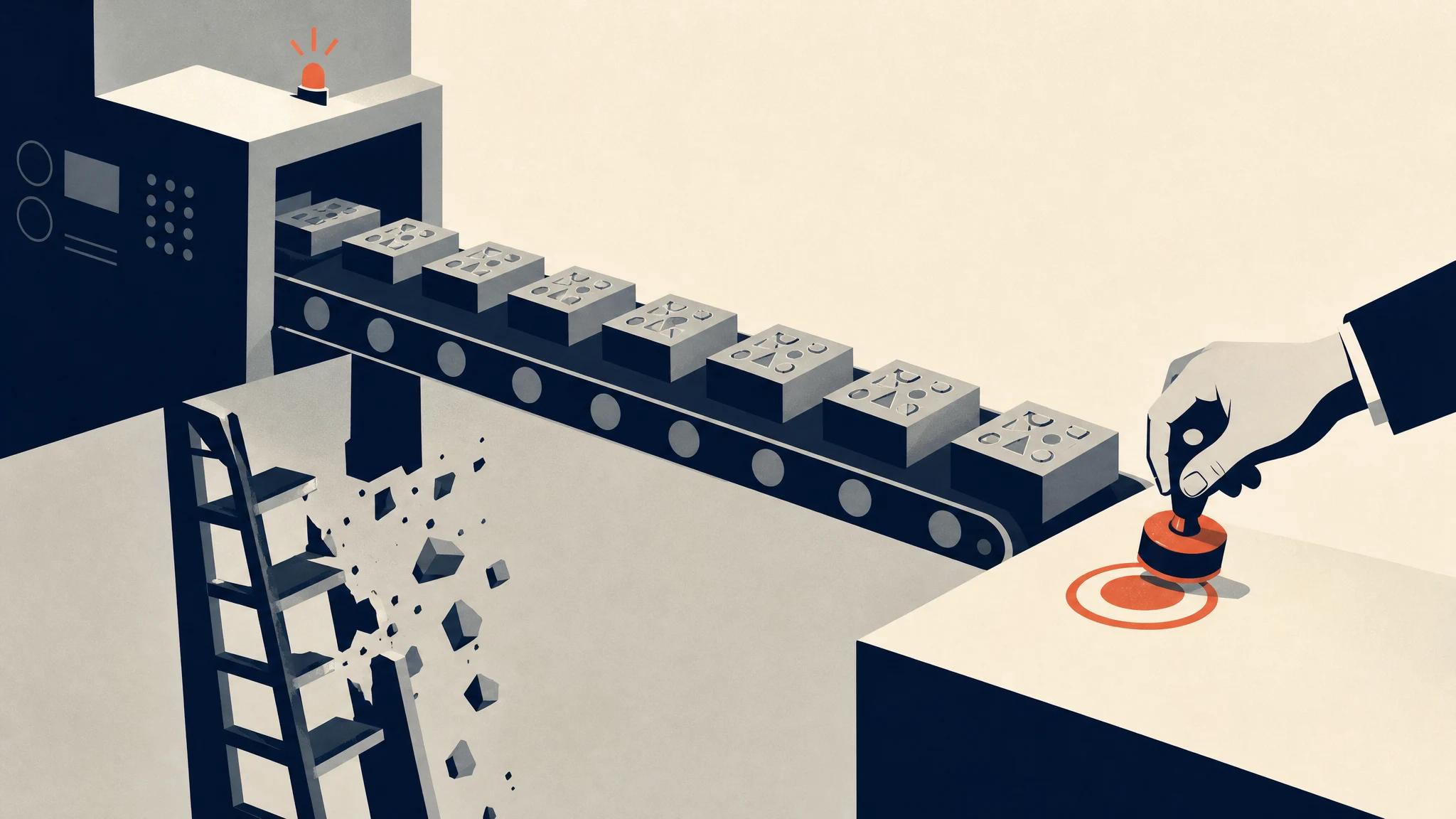
A strong counterargument exists: since AI-written code cannot be trusted, humans must still review all of it, so jobs will not actually decline. This is only half-right. It is true that review work will increase — but review is a different capability from writing. It is senior work that requires understanding the entire system and judging risk. In other words, what changes is not the total volume of work but the distribution of work. Writing jobs at the bottom diminish; only verification and design jobs at the upper layers remain. The pyramid, in effect, reshapes into a jar.
Korea's opportunity is therefore paradoxically clear. It lies in moving away from being a 'supplier of cheap code-writing labor' and climbing toward selling verification and architecture. Formal verification, security auditing, and domain-specific system design are areas where automation remains incomplete and trust commands a premium. Companies that rebuild the workforce model underpinning the SI subcontracting structure into a 'model that sells judgment' will claim the defining position of the next decade.
The Future Lies Not in the Tool, but in the Intersection
Viewing code-generating AI only as 'a tool that replaces developers' leads either to fear or to dismissal. Both reactions are wrong. This technology is interlocking with cloud, verification, data, and education to restructure the very architecture of software production. Writing moves down; judgment moves up.
The future will not come from a single technology called code-generating AI. It will come from the intersection where that technology meets deployment infrastructure, verification technology, and education. The position Korea needs to secure is also at that intersection — not the position of manually typing out code, but the position of bearing responsibility for code that machines produce.
This article was automatically translated from the Korean original by AI. For the authoritative version, read it in Korean.
한국어 원문 읽기 →