Electricity Is the Next Reserve Currency
In an era where computation translates directly into energy, the AI infrastructure race has shifted from chips to the cost of capital behind power. Where does Korea's grid stand in this exchange-rate game?
AI Summary
The global AI infrastructure race has shifted from chip supply to the cost of power, with data centers and generation assets acting as interest-rate-sensitive, long-duration investments whose economics are shaped by local electricity tariffs, dollar strength, and capital costs. Korea's world-class grid stability and proximity to generation in its southeast region offer real advantages, but transmission bottlenecks, tariff volatility, and slow grid interconnection approvals risk driving global AI capital to cheaper energy exchange rates elsewhere. If electricity is the next reserve currency, Korea's strategic question is whether it can fix that exchange rate on favorable terms—or be left importing computation at prices set by others.
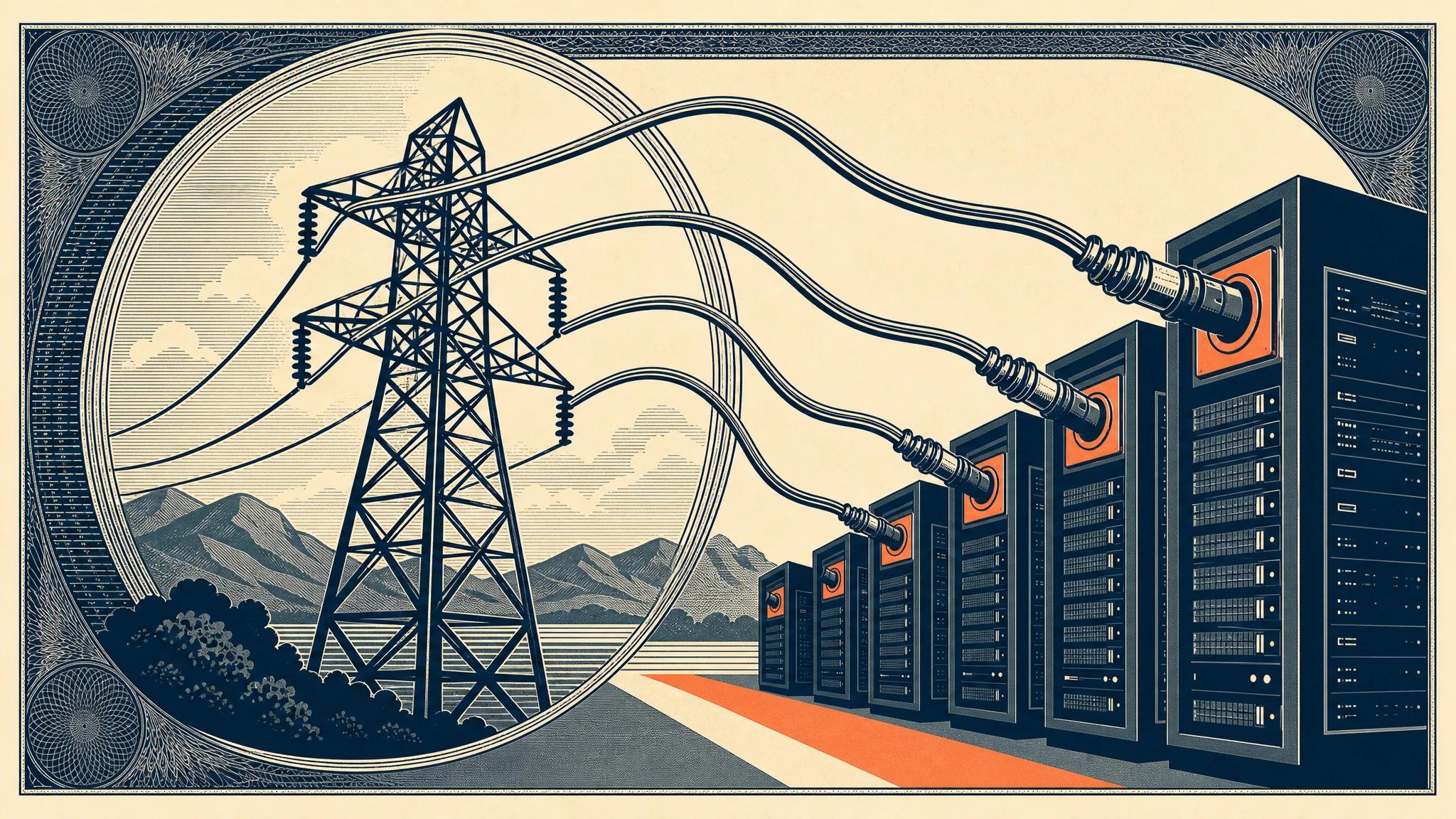
To see where money is flowing right now, look not at chip price tags but at electricity bills.
The word that appeared most frequently in Big Tech's capital expenditure guidance this year was not GPU—it was power. The capital Microsoft, Amazon, Google, and Meta have committed to data centers has climbed into the hundreds of billions of dollars annually, and what is constraining that spending is not chip supply but transmission and generation. Markets have quietly begun pricing in this shift.
Computation is, at its core, another name for energy. Each training run, each inference call, burns a fixed number of joules. The real currency of AI infrastructure is therefore not tokens but kilowatt-hours. To buy computation, you must exchange it for power. The key insight is that this exchange rate varies from location to location, country to country.
This is where interest rates enter the picture. Data centers are long-duration assets: capital is committed upfront and recovered over many years. Higher interest rates erode the present value of those future cash flows. Power plants and transmission lines are even more sensitive—with payback periods measured in decades, they are among the asset classes most exposed to the cost of capital. Power infrastructure is, at its core, a bet on interest rates.
The U.S. Federal Reserve, even after bringing inflation under control, has not returned policy rates to the near-zero levels of the past. The cost of money has hardened at an elevated level. Yet AI capital expenditure shows no sign of stopping. Investment continuing in the face of high capital costs signals either that expected returns are priced even higher—or that the fear of falling behind has overwhelmed the discount rate. Either way, the risk is growing.
Consider the dollar. Global AI capital is raised in dollars and spent in dollars on chips. When the dollar is strong, the cost for non-dollar countries to build the same power infrastructure rises by exactly that exchange rate. When Korea moves to develop a 1GW-scale data center campus, the more its equipment and debt are dollar-denominated, the more directly a weakening won translates into higher capital costs. The exchange rate is the hidden tariff in the competition for data center locations.
Global capital is therefore not moving simply because 'AI is promising.' It flows toward places that combine cheap power, reliable transmission, favorable regulation, and a tariff structure that allows capital recovery—all at once. That is why certain U.S. states, Middle Eastern oil producers, and Nordic countries are using low electricity costs and cooling conditions as weapons to attract data centers. Capital follows yield per unit of power, not narrative.
Korea occupies an ambiguous position on this map. Its power quality and grid stability rank among the best in the world, and a semiconductor ecosystem sits close at hand. Yet electricity demand in the Seoul metropolitan area is already strained, and generation is concentrated mainly in the south and along the coast, making transmission lines a bottleneck. The Southeast—including Busan—has the advantage of proximity to generation, but the tariff structures and grid interconnection rules that would convert that electricity into data center revenue have not yet been designed to compete in this exchange-rate game.
The trajectory of industrial electricity tariffs is decisive. If rates rise, the cost of exchanging capital for computation in Korea increases and capital departs for cheaper exchange rates. Conversely, keeping rates artificially low forces public utilities such as KEPCO to absorb the losses. Power is a public good, but AI capital is chasing private returns. Who mediates that tension—and at what price—is the essence of the location competition.
There is a counterargument. Some hold that technology breaks through on efficiency regardless of capital costs—that as performance per watt improves year after year, delivering more computation from less power makes interest rates and exchange rates secondary. There is merit to this view. But efficiency gains do not reduce demand; they expand it. When things get cheaper, more is consumed. Even as the cost per unit of computation falls, total power demand rises, and grid and capital constraints reassert themselves. Efficiency does not eliminate the exchange rate. It simply increases the volume of currency exchanged.
Moreover, the costs saved through efficiency flow right back into larger models and more inference. Capital markets demand it. Without growth, valuation multiples compress; with compressed multiples, the next funding round becomes harder. Technology companies have never, for a single moment, escaped the gravitational pull of capital costs.
The real question, then, is not 'How fast is AI?' It is 'At what interest rate and exchange rate is the money to buy that speed being raised?' The same model, the same chips—run where capital is cheap, you win; run where it is expensive, you lose. The technology is flat. The capital landscape is steep.
The conditions under which Korea can seize opportunity are clear: grid investment that breaks transmission bottlenecks, location-based tariff structures that incentivize data centers to site near generation, and long-term stable policy signals that lower the cost of capital. The conditions for exposure to risk are equally clear. If won weakness persists, if electricity rates remain volatile, and if grid interconnection is delayed by years, capital will quietly switch to a better exchange rate elsewhere.
Power is already a macroeconomic variable. Computation demand is energy demand; energy demand is a capital cost problem; capital cost is a function of interest rates and exchange rates. Translate AI into power, and power into capital, and the winners and losers of this competition come into view.
The speed of technology makes headlines. But the price placed on that future is set by interest rates and the dollar. If electricity is the next currency, Korea has one question to answer: Can we fix this exchange rate in our favor—or will we be importing computation at a rate set by others?
This article was automatically translated from the Korean original by AI. For the authoritative version, read it in Korean.
한국어 원문 읽기 →