Verification Is the Next Infrastructure
Companies that grade models are occupying a deeper position than companies that build models. The moment trust becomes a bottleneck, evaluation becomes not a tool but an industry.
AI Summary
As AI models proliferate, independent verification and evaluation are emerging as a critical industry layer separate from model development itself. Like SSL certificates enabled e-commerce and external auditors verify financial statements, third-party AI evaluation firms are becoming essential infrastructure to establish trust in high-risk domains. This shift creates opportunities for regions like Korea and Busan to establish evaluation standards in sectors where they have domain expertise, even without competing in foundation model development.
Everyone Only Sees Models
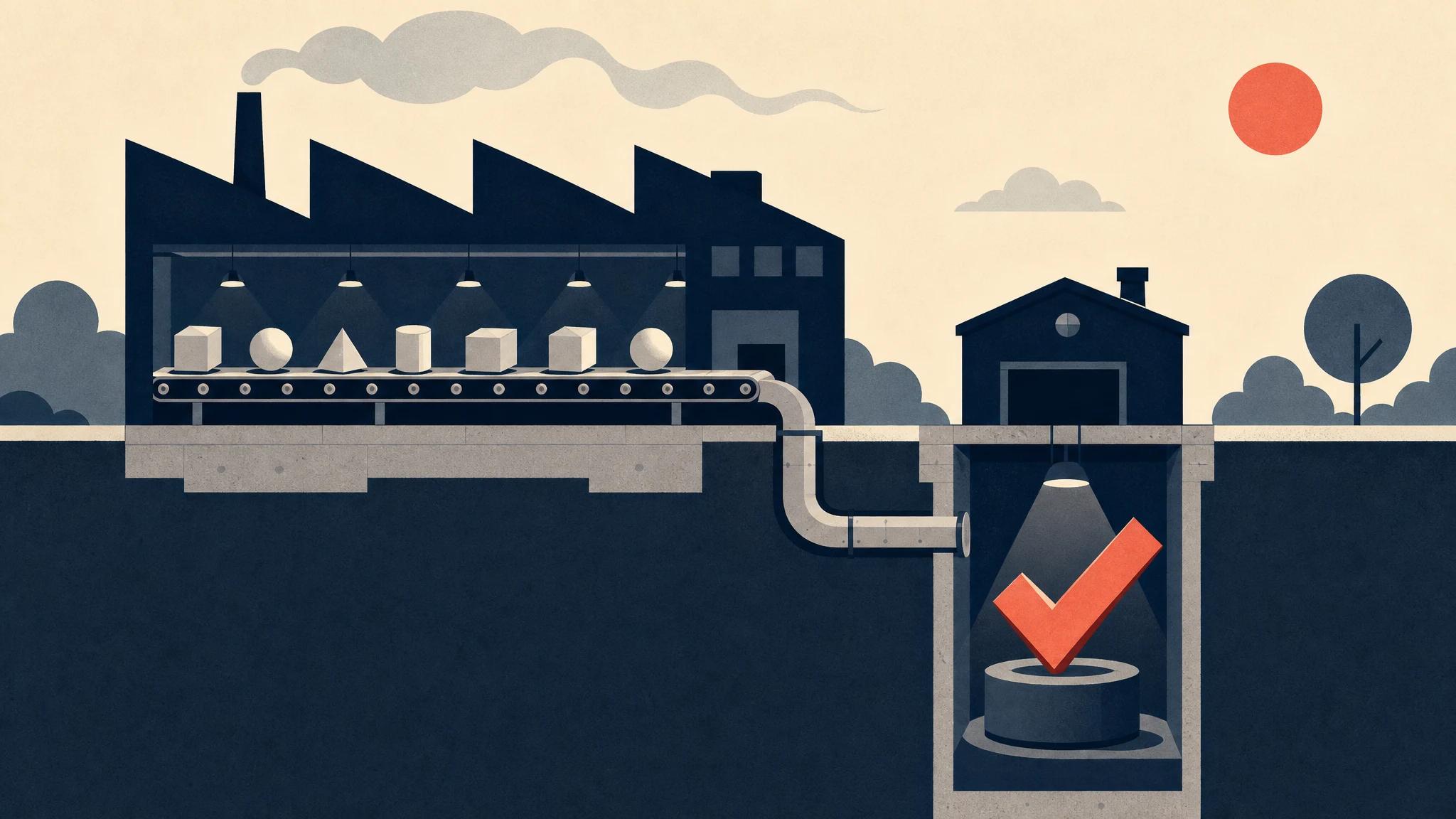
The subject of AI news is almost predetermined. Who released a bigger model, who broke benchmark records. The public reads this industry as a model-building race. But this perspective leaves one entire space blank. After everything is built, who verifies whether that model actually works as promised?
If this question seems trivial, consider the opposite case. Pharmaceutical companies make new drugs, but regulatory agencies and clinical trial organizations verify whether they can be marketed. Companies prepare financial statements, but external auditors guarantee their reliability. When an industry matures, makers and verifiers split apart. At precisely that point, evaluation breaks off as an independent industry. In AI, that separation is beginning now.
How Convergence Changed Industries
The history of technology is not a history of single technologies but of combinations. The shipping container was just a metal box in the 1950s. When it interlocked with standard specifications, cranes, and port computer systems, global trade logistics costs collapsed. The innovation wasn't the box—it was the standards and verification systems that made the box trustworthy.
The internet was similar. Commerce didn't happen with HTTP alone. Only after the trust layer of SSL certificates and certificate authorities was attached did people enter their card numbers. A single padlock icon unlocked e-commerce. What determined the speed of technology adoption wasn't functionality, but the existence of a third party willing to assume responsibility for trust.
AI is on the same path. Model performance is already sufficiently impressive. What's holding it back isn't performance but trust. Does this model hallucinate in medical consultations? Does it produce discriminatory outputs in financial advice? Could it be exploited for security bypasses? Who will believe scores assigned by the company that built it? The industry's trust bottleneck won't be resolved with a structure where you grade your own test.
Technologies That Evaluation Connects
If you view evaluation only as a tool, it's just a test suite. View it as a connection point, and the picture changes.
Evaluation meets data. Good evaluation is a data pipeline that continuously collects new failure cases, and that data becomes fuel for model improvement. Evaluation also meets regulation. The EU AI Act requires conformity assessments for high-risk AI, which means a market emerges for someone to conduct those assessments. Just as accounting firms captured the audit market. Evaluation meets security. Red teams, prompt injection tests, model jailbreak attempts are channels through which the entire cybersecurity industry migrates toward AI. Evaluation meets domains. To grade medical AI requires medical knowledge; to grade legal AI requires case law knowledge. So evaluation spawns different companies for each vertical industry.
Here we see new economic actors: model auditors, benchmark operators, domain-specific evaluation certification bodies, AI insurance underwriters. Insurance underwriters must score model reliability to set premiums. They don't build models. They sell the authority to determine whether a model can be trusted. It's the position that emerges last in the value chain but remains the longest.
The counterargument is clear: evaluation will ultimately be absorbed internally by model companies or become free through open-source benchmarks, preventing it from growing as an independent industry. That's half right. Basic capability measurement will be commoditized. But where conflicts of interest exist, self-grading cannot generate trust. For the same reason companies cannot audit their own financial statements, evaluation in high-risk domains structurally moves external. The more free benchmarks proliferate, the higher the scarcity value of accountable third-party verification rises.
The Space Korea Has Empty
Korea is outmatched in capital scale in the foundation model race. However, the evaluation layer is a market entered not through capital but through domain depth and institutional trust. In areas where Korea has accumulated data and regulatory experience—like healthcare, finance, and manufacturing—whoever first establishes evaluation standards tailored to the Korean language and Korean systems holds the standard. Hold the standard, and no matter where the model comes from, it gets its approval stamp here.
Using Busan as a coordinate point makes it more concrete. Busan is a rare city that simultaneously possesses domain assets of ports and logistics, healthcare, and financial hub designation. An institution that verifies logistics AI safety with port field data, a consortium that grades regional medical AI in clinical context—these stand more naturally here than in Seoul. Even if we can't build models, we can build institutions that determine whether those models can be trusted.
The Future Comes from Connection Points
The rise of AI evaluation companies appears to be a small signal. But just as SSL certificates did, the verification layer that looks small now becomes the next decade's infrastructure. This signal says one thing: the future doesn't come from one bigger model. It comes from the connection points where models meet data, regulation, security, and domains to be translated into trust. While watching the race to build, the real blank space is opening on the grading side.
This article was automatically translated from the Korean original by AI. For the authoritative version, read it in Korean.
한국어 원문 읽기 →