Dollars Flow as Code
Stablecoins are not new technology but a new plumbing for dollar liquidity. What do Korean remittance and commerce startups gain and lose on this rail opened by regulation?
AI Summary
Stablecoins represent a fundamental shift in dollar liquidity infrastructure rather than a payment innovation, with their viability driven by U.S. interest rates and regulatory clarity rather than technology alone. As regulatory frameworks in the U.S., Europe, and Korea legitimize stablecoins, they lower capital costs for fintech startups while simultaneously deepening dollar penetration into local economies. For Korean startups, this creates opportunities in cross-border commerce and remittances but also exposes them to currency and interest rate risks that become embedded in their business models.
Not Payments, but Dollar Movement
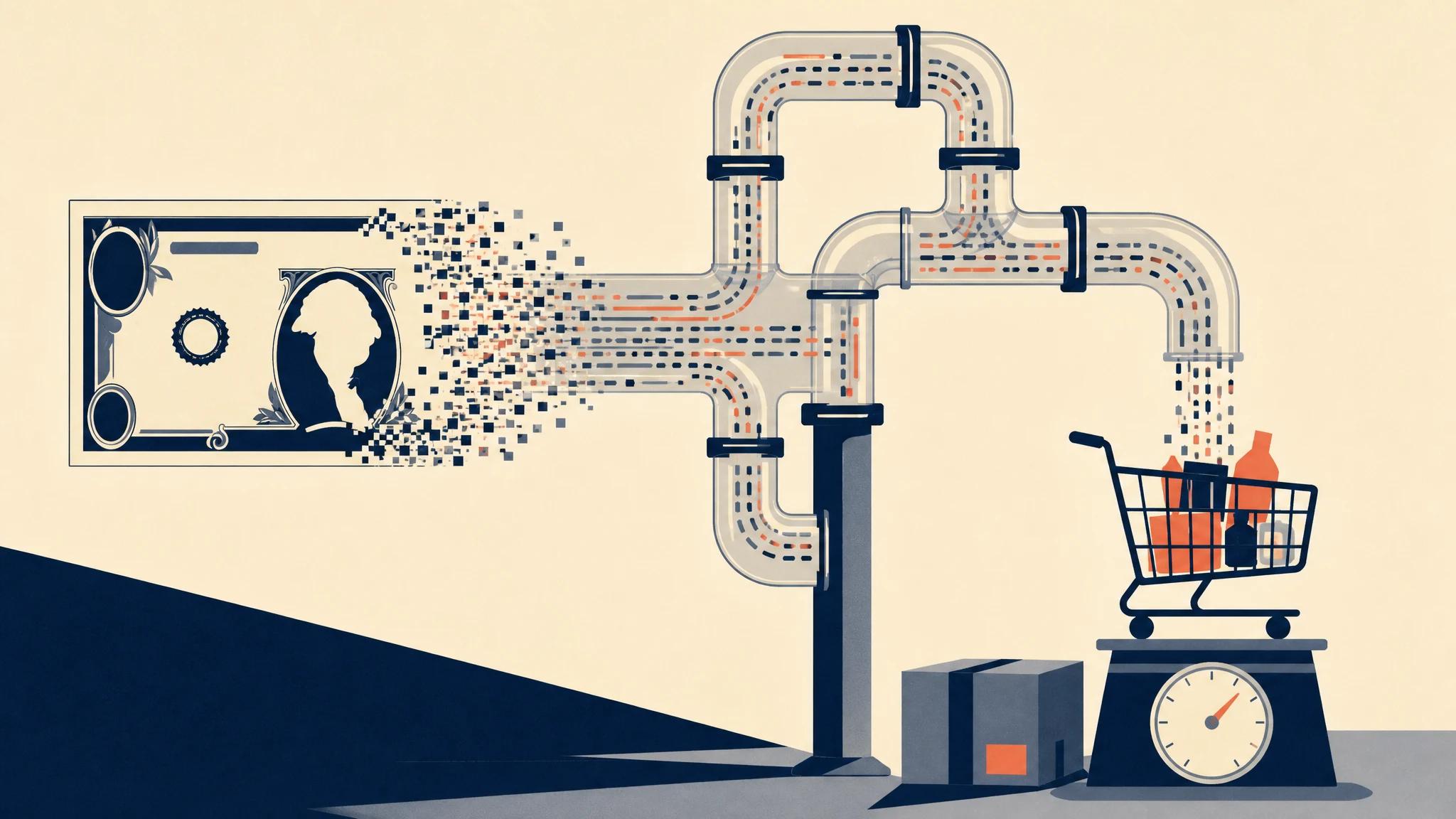
Reading stablecoins as a payment innovation misses the core point. This is not a story about payments but about the plumbing of dollar liquidity changing.
The reserve assets held jointly by Tether and USDC are mostly U.S. short-term Treasury bonds. Every time an issuer mints tokens, that amount of dollars flows into Treasuries, and the tokens scatter to wallets worldwide. Ultimately, stablecoins are a mechanism for people living outside the U.S. to borrow dollar short-term rates without a bank account. Users feel they're holding a payment method, but from the system's perspective, what has happened is the demand curve for dollar-denominated bonds has shifted one notch upward and to the right.
So the question must change. Why now, of all times? The tokens of 2022 were the same tokens, but they didn't become payment rails. What changed wasn't the code but two macro variables. While U.S. policy rates stayed around 5 percent, dollar reserve assets delivered massive interest income to issuers, and that income became the engine driving issuance sustainably. On top of this, regulation pulled tokens' legal status out of murkiness.
Rails Built by Interest Rates, Ties Laid by Regulation
The U.S. passed legislation last year designating payment stablecoins as a separate asset class. Issuers bear the burden of 1-to-1 reserves and audits, and in return, tokens escaped the gray zone. Europe laid the framework one step ahead with MiCA, and Korean financial authorities have also placed won-denominated stablecoin institutionalization on the public agenda.
The gift regulation gives fintech startups lies in an unexpected place. Not legality itself, but the decline in capital costs. When you build a business on gray-zone assets, investors demand a regulatory risk premium. Even for the same business, the discount rate rises and the present value of future cash flows gets cut. The moment legal status becomes clear, this premium drops out and the cost of raising capital falls. The sudden increase in startups on stablecoin rails isn't because the technology got better, but because the cost of putting money on those rails became cheaper.
Here the two faces of interest rates diverge. For issuers, high rates are a subsidy in the form of reserve asset interest. Conversely, for fintech startups doing business on top of that, high rates remain a capital cost. The same interest rate fattens the rail owner while pressuring the rail user. When the U.S. starts lowering rates, the issuers' interest engine will cool, but startups above it will see easier fundraising. This asymmetry is the real cycle of the stablecoin ecosystem.
When Cross-Border Settlement Costs Collapse
What stablecoins actually break isn't distance but the layers of correspondent banking. Right now, when money is sent from Korea to Southeast Asia, it passes through multiple intermediary banks, and at each layer, fees, foreign exchange spreads, and one or two days of time lag accumulate. This cost structure has long determined the competitive landscape for Korean remittance and commerce startups.
Stablecoin rails skip these intermediate layers. Payments a Korean seller receives from a Southeast Asian buyer settle instantly as dollar tokens, and currency exchange happens only at both endpoints. Days become seconds, and multiple layers of spreads shrink to one. In cross-border e-commerce where the turnover speed of working capital determines business survival, the disappearance of settlement lag is not simple cost reduction but a structural change in capital efficiency.
Looking at Busan makes this change less abstract. In a city that lives off ports and logistics, payments for export SMEs have always been exposed to dollar time lags and exchange rate fluctuations. When settlement rails shift to tokens, this time lag exposure decreases. Of course, risks follow along.
The Discount Korea Receives, The Risk Korea Bears
Here it becomes clear why the Korean market always gets discounted. The won is not a reserve currency, and Korea is a small open economy sensitive to capital inflows and outflows. If stablecoins effectively mean dollars, then those rails being laid in Korea means the dollar is penetrating one step deeper at the payment level. When individuals and businesses can more easily leave the won and stay in dollar tokens, the capital control levers held by monetary authorities loosen. This is why authorities are rushing to institutionalize won stablecoins while remaining cautious about dollar token inflows. It's not about defense but monetary sovereignty.
There's a strong counterargument. The claim that stablecoins are just payment technology, competing on efficiency regardless of macro variables. It's half right. The act of moving tokens itself is independent of interest rates. However, the reason those tokens exist, the power driving issuance, and the speed at which startups flock to them are all functions of dollar short-term rates and regulatory discount rates. Technology processes payments, but who can process those payments and why is determined by capital costs. Efficiency cannot overcome cycles.
So the opportunity Korean startups can seize and the risk they'll bear are two sides of the same coin. The collapse of settlement costs lowers entry barriers for remittance and cross-border commerce startups. Simultaneously, the moment a business is placed on dollar rails, the business's working capital becomes directly exposed to won weakness periods and U.S. interest rate fluctuations. Currency hedging becomes part of the business model.
Looking only at technology's speed, the rails are already laid. But which direction money flows over them and at whose cost is determined by interest rates and exchange rates. Stablecoins aren't swallowing payments—rather, dollar liquidity has donned the shell of code and descended to the payment level. What Korean startups need to watch isn't the speed of tokens, but which way dollars are flowing behind those tokens.
This article was automatically translated from the Korean original by AI. For the authoritative version, read it in Korean.
한국어 원문 읽기 →