Only the Survivors Get to IPO
Reading the 2026 IPO rebound as recovery would be a mistake. Statistics only capture companies that survived, while those that quietly died have been erased from the denominator. Down rounds haven't ended—only companies that could withstand down rounds remain on stage.
AI Summary
The anticipated 2026 tech IPO rebound reflects survivorship bias rather than market recovery, as statistics only capture companies that endured the high-interest environment while many others quietly disappeared. The shift from zero-interest rates to higher rates transformed dry powder from growth-betting capital into funds concentrated on a verified few, primarily AI and infrastructure winners. Korean startups face a double discount as global capital flows to U.S. big tech and currency risk adds to their cost of capital.
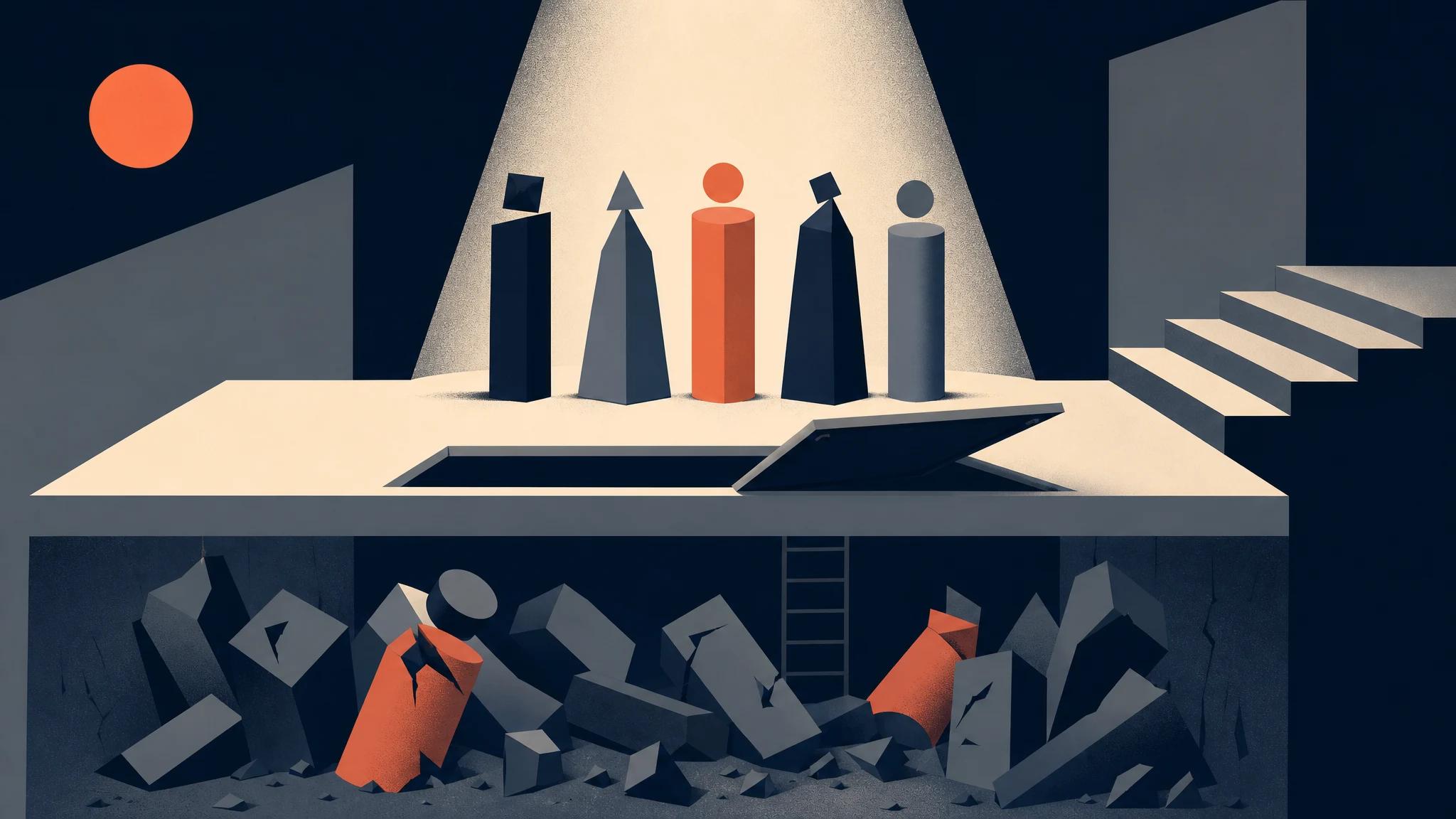
In the first half of 2026, word is circulating that several U.S. tech companies are knocking on the IPO door again. The market wants to read this as "winter is over." I see it differently. What's over isn't winter—it's the companies that couldn't survive it.
First, we need to change how we count. The IPO rebound is a story about the numerator—companies that successfully went public. But to judge recovery, you need to look at the denominator: all the companies that started together in 2021. A significant portion of that denominator isn't in any IPO statistics now. They didn't disappear from the statistics—the companies themselves disappeared.
This is survivorship bias. The error of only looking at where bullets hit the planes that returned, while excluding planes that were shot down and never came back from the data. The 2026 IPO list is the roster of those returning planes.
Why did this structure emerge? The starting point wasn't technology but interest rates. The 2021 valuations were essentially a function of zero interest rates. When the discount rate approaches zero, even distant future cash flows are assigned high present value. Even loss-making "someday" sold at a premium.
Then the U.S. Federal Reserve raised rates rapidly. When the discount rate rises, the first thing to get cut is the most distant future. The further out a company's profits—five, seven years away—the more dramatically its present value shrinks. Growth stocks' sensitivity to interest rates isn't about sentiment; it's arithmetic.
So down rounds began in 2022. Companies either raised their next round at lower valuations or couldn't raise at all. This is where companies split into two paths.
One group had sufficient cash, generated revenue enough to cover capital costs, or ruthlessly cut expenses to extend their runway. The other group had their next funding cut off. The latter were quietly liquidated, acquired at fire-sale prices, or absorbed through acqui-hires where only employees were extracted.
"Quietly" is the key word. Death has no headlines. IPOs ring bells. So our eyes only catch the bell-ringing, while funerals are omitted from the statistics.
This is where we need to look at dry powder—committed capital that venture and private equity funds haven't yet deployed. It accumulated astronomically around 2021, and much of it still remains. On the surface, "there's plenty of money." But the nature of this money has changed.
Dry powder in the zero-rate era was "money betting on growth." Today's dry powder, with rates up, is "money concentrating on an already-verified few." Even if the total amount is the same, distribution is extremely skewed. Rounds concentrate on a handful of AI and infrastructure winners, while the rest can't open rounds at all. The fact that there's plenty of money and the fact that money comes to your company are different propositions.
So the 2026 IPO rebound isn't a recovery of liquidity but the result of liquidity selection. It's a picture of the surviving few monopolizing the sunshine of dry powder and walking out to IPO having soaked it up. What looks like recovery is because dead samples have dropped from view.
There's a strong counterargument: "If the technology itself is good enough, interest rates are secondary. AI is a productivity revolution that overwhelms the cost of capital, so cycle logic is outdated." It's a valid point. For the few genuinely generating cash, it's true. Except that word "few" already concedes survivorship bias. What overwhelmed the cost of capital wasn't technology in general, but only those companies that managed to overwhelm it. The rest were erased from the denominator even while holding the same technology in the same interest rate environment.
The Korean market gets discounted twice in this structure. Once as global capital flows to dollar assets, especially U.S. big tech and AI infrastructure, pushing down the priority of emerging market growth stocks. And again through the won. When the dollar is strong and the won is weak, foreign investors face currency loss risk on Korean stocks, adding a currency premium to the cost of capital. Whether in Busan or Pangyo, good technology ends up using more expensive capital. To see if Korean startups' down rounds have ended, look not at KOSDAQ bell-ringing but at won-denominated capital raising costs and foreign investor net buying direction.
To summarize: IPO lists are evidence of selection, not recovery. The real data of the cycle isn't who went public, but who disappeared without even making the list.
The claim that down rounds have ended is only half right. They've ended only for companies that could withstand down rounds. For those that couldn't, it wasn't an ending but a termination. As much as how fast technology moves, the more accurate question now is who money chooses to flow to.
This article was automatically translated from the Korean original by AI. For the authoritative version, read it in Korean.
한국어 원문 읽기 →