G-Star's True Coordinates
The booth sizes at Busan's BEXCO represent not marketing budgets but the scale of bets. It's a map unfolded once a year showing who wagered their company on one shot, who quietly disappeared, and who collected the tolls. If you only read this as new game reviews, you miss the underlying cost structure.
AI Summary
G-Star, Korea's major game exhibition held annually at BEXCO in Busan, reveals the capital structure and power dynamics of the Korean gaming industry beyond flashy game demos. Booth sizes reflect strategic bets rather than marketing spend, while invisible players like Tencent exert influence through capital stakes. The Korean gaming industry faces a structural challenge: despite world-class production capabilities, much of the distribution channels and capital returns are controlled by external platforms, leaving Korean studios as high-quality suppliers with limited control over global distribution rights.
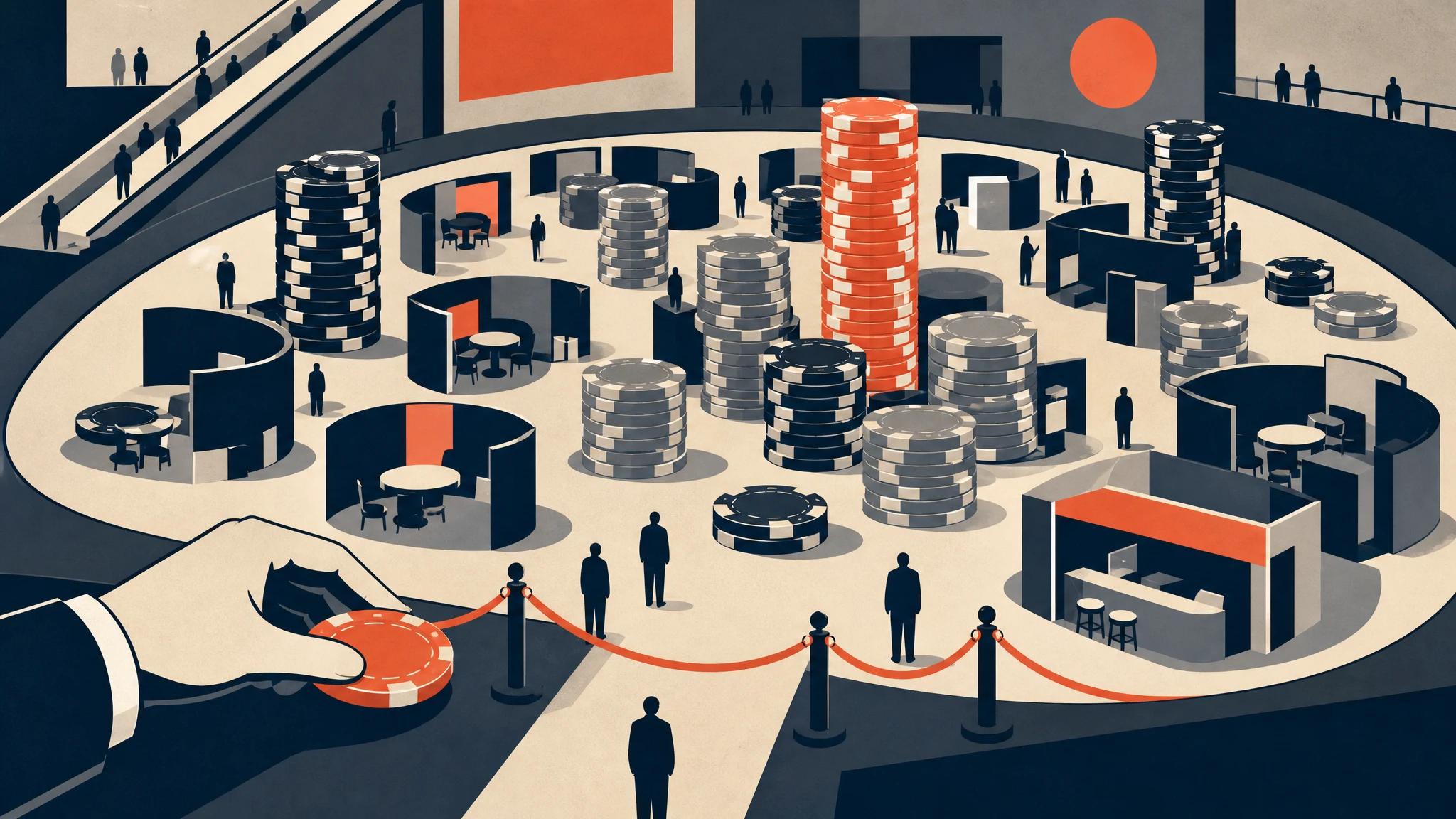
BEXCO in November divides into two floors. The first-floor B2C hall has cosplay and demo queues, while the upper B2B hall has contracts and publishing meetings. Audiences see the first floor, but the industry is decided on the second.
So summarizing G-Star as 'which game was most fun this year' is like summarizing a film festival by red carpet dresses. It's not wrong. But you haven't caught a single word about where money actually flows in and out.
The first thing to look at is the main sponsor position. The main sponsor seat goes to companies that can—or must—stake their company's fate on their new release that year. Booth size isn't marketing budget but the scale of the bet. Who erected the biggest booth is the same as asking who's most desperately aiming for a big hit.
Nexon's annual large booths aren't simple showmanship. Nexon operates on a structure of layering new title lineups atop stable cash flow from live services. Large booths are capital signals saying 'we have the stamina to inject this much into new titles every year.' It's a signal aimed not at audiences but at investors and competitors.
Krafton is different. A single IP, Battlegrounds, supports the entire company. The question to ask when reading Krafton's booth strategy isn't 'are there fun new titles' but 'how are they trying to diversify cash flow tied to one IP into the next 100 input variables.' The existence or absence of a next-title lineup is essentially the company's risk diversification table.
Here's where we twist perspective. What really matters at G-Star isn't 'what appeared' but 'what didn't appear.' When a major publisher drops out of main sponsorship, that's not marketing cost-cutting. It's either a confession that they have no confident big shot to present that year, or a signal that capital's center of gravity has shifted outside the exhibition hall. Silent zones speak more than the exhibition floor.
Look at Pearl Abyss's Crimson Desert filling booths for years with 'coming soon.' An unreleased anticipated title is itself an asset. Unreleased anticipation props up stock prices, and those stock prices draw in next development funding. Since launch is the moment expectation settles into cash, there's a structurally rational incentive to postpone settlement day. It's not a moral issue but a capital structure issue.
Now the biggest shadow: Tencent. Without a single square meter of booth space, Tencent holds half of G-Star's terrain. They hold Krafton shares and have capital in multiple Korean studios. Not being visible at the exhibition doesn't mean absence. Those who collect tolls usually sit not at the exhibition entrance but at the capital table.
Here's the core structure. Korea's gaming value chain splits into two segments: 'production' and 'distribution.' Production is handled by Korean studios. But the distribution channels taking those games to China, Southeast Asia, and globally, plus much of the initial capital invested in production, are largely held by external platforms and external capital. Korea makes it; channels take the big share.
I'll take the counterargument head-on. 'G-Star is just a game expo. What capital conspiracy exists in booth sizes—it's just marketing schedules and new release timing aligning.' Half right. Single-year booth arrangements are heavily influenced by the coincidence of release schedules. Determining power structures from one year's data is over-interpretation.
That's why booths should be read as time series, not snapshots. Who holds main position three years running, who quietly disappears, which direction is the overseas booth ratio moving in the B2B hall. One year is coincidence, but a three-year pattern is capital's center of gravity. The only way not to mistake coincidence for structure is to ask the same questions identically every year.
Smilegate is worth reading as an exception to this structure. They earned massive cash in the Chinese market with CrossFire but remain unlisted. Being able to carry long-term projects like Lost Ark without quarterly pressure from external capital is because the axis of trust remains internal rather than with external investors. Whose incentives reward decision-making—that answer differs by company.
Let's fix Korea's coordinates. By adoption curve, Korea's gaming industry is already a massive market in maturity stage. The problem is that mature market bottlenecks exist externally on both distribution and capital sides. In the US-China platform game, Korea is a supplier with world-class production capability, but doesn't hold veto power over global distribution. Viewed from Busan, the classic structure emerges: the best makers take the least.
A question you can use tomorrow on the same beat: Don't ask about booth area—ask 'did this company's ratio of distributing their own IP through their own channels increase or decrease from last year?' If self-distribution increases, they're moving toward the taking side; if external publishing dependence increases, they're descending toward the toll-paying side.
One hidden risk: Stock prices propped up by unreleased anticipated titles look like a kind of perpetual motion machine. Expectation draws funding, funding extends expectation. But the real cash source in that circuit is ultimately launched title revenue. When settlement day is postponed indefinitely, risk doesn't disappear—it passes to next quarter's investors. Expectation's maturity date always comes.
So G-Star isn't a spectacle. It's the coordinates Busan unfolds once a year showing where capital in Korea's gaming industry flowed through which segments, who held the tolls, and who wagered their company on one shot. Companies that read this only as new game reviews and move on will face next November again without seeing where their next cost structure is determined. The cost of watching always gets billed on the next balance sheet.
This article was automatically translated from the Korean original by AI. For the authoritative version, read it in Korean.
한국어 원문 읽기 →