When Your Wallet Becomes Your Payment Account
PlayStation's consideration of stablecoin payments is not simply about more convenient transfers. When the friction between in-game money and real-world money disappears, the fun and monetization structures built atop that friction are set to shake.
AI Summary
Sony's reported exploration of stablecoin integration into PlayStation's payment network threatens to dissolve the intentional friction between in-game and real-world currency that has long underpinned game monetization design. By eliminating the conversion delay that dulls players' awareness of their spending, stablecoins could force a reckoning with monetization models built on psychological distance from real money. For Busan's indie studios, this shift paradoxically opens a niche: games that treat friction, constraint, and the unbuyable nature of earned achievement as the product itself.
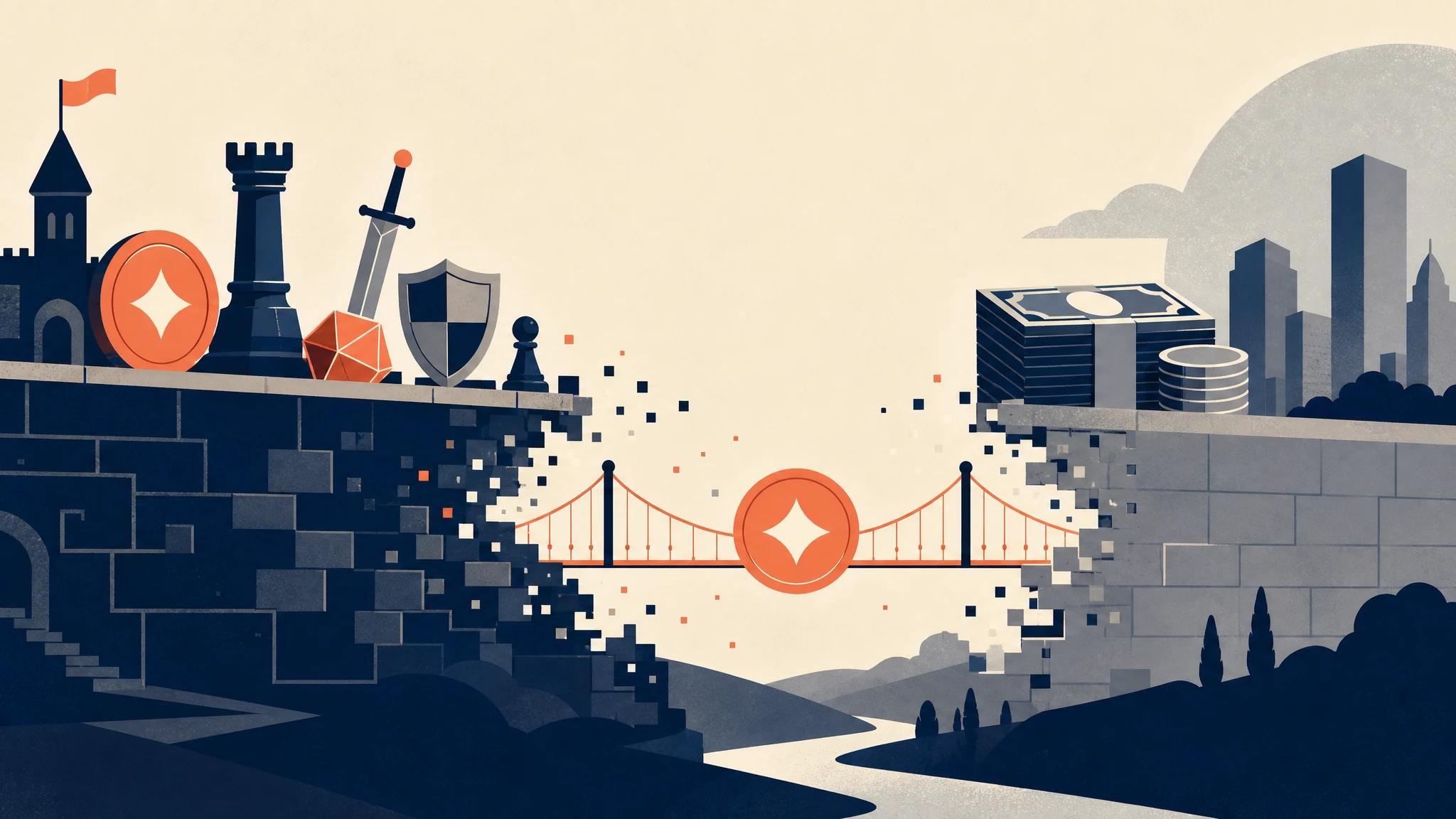
In-game currency has always been fake. More precisely, it was designed to pretend to be fake. Gold, gems, credits — whatever the name — they were separated from real-world won or dollars by a single membrane, and that membrane held up nearly everything in the game economy. Real money was spent only at the top-up screen; once inside, that money changed color. The color change is the key.
When I hear news that Sony is exploring the integration of stablecoins into PlayStation's payment network, I don't read it as one more payment option being added. I read it as a signal that the oldest and quietest mechanism in game design — the intentional friction between in-game currency and real-world currency — is being removed. A mechanism that no designer ever explicitly built, yet one that every monetization structure has leaned on.
The membrane that changed color disappears
Why did games insist on inserting an intermediate currency layer instead of accepting cash directly? Not for convenience. The moment a 990-won bundle becomes 110 gems, and a skin is priced at 120 gems, players can no longer instantly calculate how much they are spending. It is a mechanism that dulls by one layer the neural response known in behavioral economics as the "pain of paying." Half the technology that makes mobile gacha dissolve hundreds of thousands of won lies in this conversion delay.
Stablecoins reverse this delay. If 1 coin is pegged to 1 dollar, no conversion is needed. The wallet balance reads like a bank balance. A paradox emerges: a payment system designed to eliminate friction simultaneously restores it. When players begin to feel the exact real-world cost of every purchase, monetization designs that relied on conversion delay will encounter a hesitating finger at their most expensive moment.
And it does not stop there. In-game currency that can be stably exchanged for real-world value means that what you earn inside a game holds value outside it. Game economies have long worked hard to prevent this. RMT — real-money trading — was banned in the terms of service of nearly every online game, and that ban was the wall separating in-game labor from real-world labor. When that wall blurs at the payment infrastructure level, we are dragged back to the same place where Diablo 3's auction house collapsed in 2014. The moment a money-buyable optimal solution exists, players stop playing the game and start calculating it. The most efficient path becomes the most boring path — a collapse.
Friction was the fun
I call every constraint a good game imposes on its players an intentional refusal. Dark Souls limiting the number of healing flasks. Indie roguelikes making you lose everything when you die. Animal Crossing letting you repay loans only slowly. These refusals give meaning to time and effort. As Nintendo's Murakami once said somewhere: without constraints, there are no choices.
An infinitely smooth payment experience is the opposite of that refusal. In a world where you can buy instantly without friction, and where what you buy immediately holds real-world value, the scarcity a game worked hard to create is reduced to a price tag. Korean MMORPGs walked that path over the past decade and more. As loot boxes and de facto real-money trading effectively merged, the boundary in many games between enjoying content and accumulating assets collapsed, and what players encountered at the end was not fun but a profit-and-loss statement. Stablecoin payments could become the infrastructure that formalizes this structure for consoles and the global market.
There is, of course, a counterargument. What is wrong with reducing friction? Is it not a fair exchange for players to buy their time with their own money? That is true. For a time-poor adult, the option to pay for progress can be an act of consideration. But games are a medium that sells experience, not transactions. The very fact that you can skip progress with money devalues the achievements of those who did not skip. On a mountain where everyone can reach the summit by helicopter, even the legs of those who climbed on foot lose meaning. Smooth payments are a personal convenience, but when that smoothness underlies an entire economy, it becomes the rules of the game.
A place for Busan indie
Faced with this shift, small studios will have to choose one of two paths: ride the payment infrastructure of major publishers and sell the same games more smoothly, or go in the opposite direction and make friction itself the product.
I believe the place for Busan's indie scene lies in the latter. Busan is the city of G-Star, and at the same time a city without the headquarters of a major publisher. The weakness of lacking the capital to build a payment network is, in the same breath, the freedom to make games where payment does not substitute for fun. In a world where stablecoins are embedded and wallets and payment accounts become one, the most paradoxically scarce product will be achievement that cannot be bought. Walls you cannot skip past with money, loops that honestly demand your time, intentionally uncomfortable refusals. What a small team in Busan can make is precisely that unbuyable quality.
Stablecoins will make games smoother. But smoothness is not a synonym for fun. Fun has always come from obstruction, constraint, and refusal, and the more payment infrastructure strips away every membrane, the more precious the games that deliberately leave some membranes in place become. In an era when wallets become payment accounts, the true luxury item is a wall that will not accept your money.
This article was automatically translated from the Korean original by AI. For the authoritative version, read it in Korean.
한국어 원문 읽기 →