Games Where Ads Become the Game
I tried out an app-tech game that embeds rewarded ads and offerwalls into its core loop. The point where fun disappeared was precise—the exact coordinates where ads began to replace gameplay.
AI Summary
This critique examines app-tech games that prioritize ad viewing over gameplay, analyzing how rewarded video ads and offerwalls replace core game loops. The author argues that when friction points are resolved through ad viewing rather than skill improvement, games become disguised labor platforms rather than entertainment. Korean indie developers are urged to preserve gameplay integrity even when monetizing through ads.
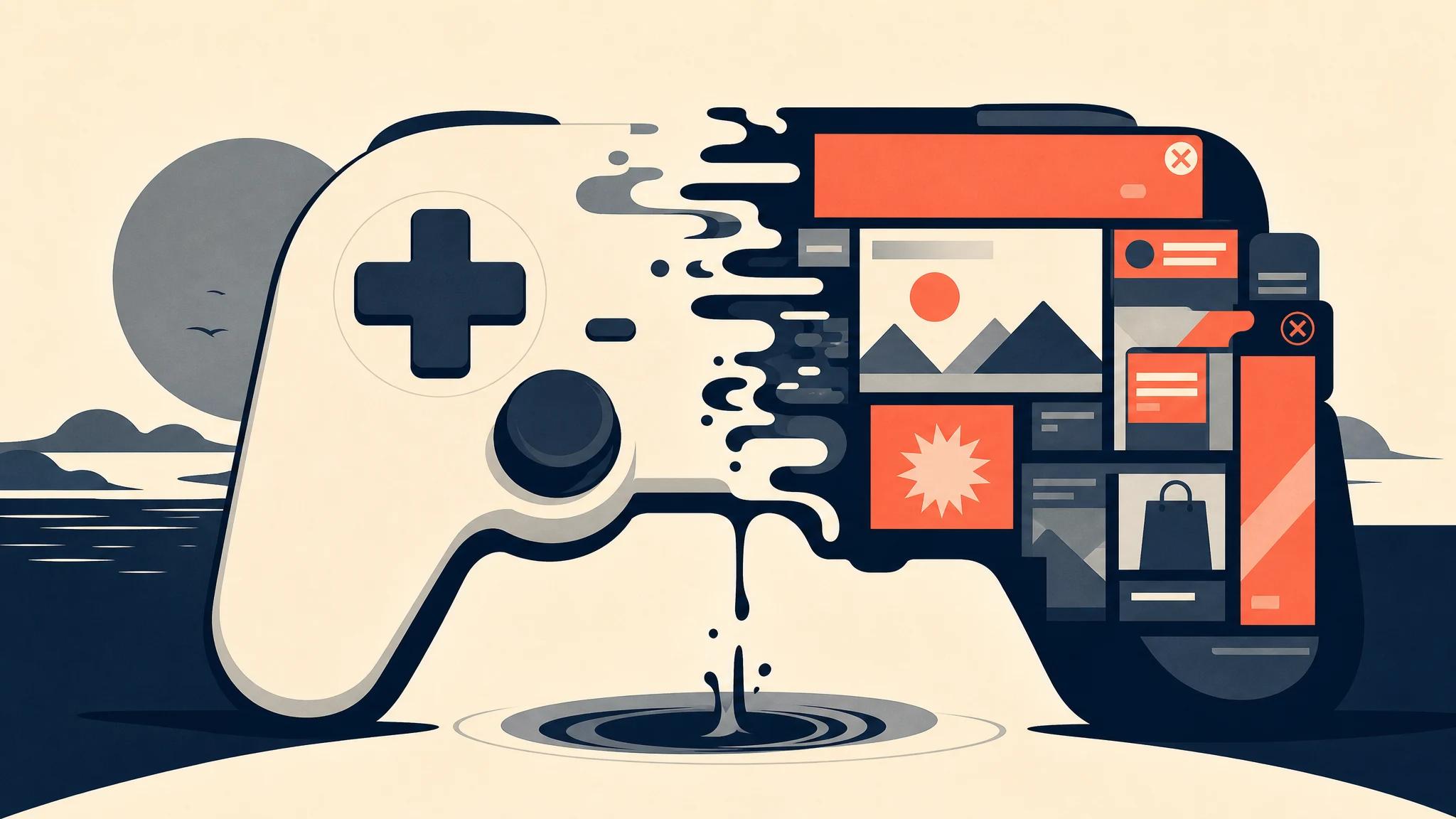
I Launched the Game, But the Game Wasn't Waiting for Me
30 seconds after installation. Coins pour out on the first screen. My finger hasn't done anything yet. This is the first signal. A well-made game gives you the first reward within 5 seconds, but disguises that reward to feel like the result of your action. Here, even the disguise is skipped. The reward doesn't come because I did well—it comes because I remained on the screen.
In Korea, this genre is called app-tech games. The surface grammar was established by luck-based tower defense titles like 111percent's Lucky Defense, and dozens of variants wearing that exact grammar with offerwalls embedded at their heart now populate the market. I'm writing based on one title I personally played. Since the genre conventions are the same, dissecting one is dissecting the pack.
The core point is this: this game's core loop is not combat. It's the offerwall. The tactile satisfaction of stopping enemies, the depth of unit combinations, the sting of failure—these three elements that should be the game's spine are here merely runways laid toward watching a single ad.
Where Friction Disappeared, a Tollgate Appeared
In game design, friction is not the enemy. Friction is the raw material of fun. Sections that almost but don't quite block you, failures that make you try once more, the 0.5 seconds of hesitation over where to spend resources. This hesitation keeps players alive.
This game placed a rewarded video button precisely where that hesitation should be. You get stuck once at wave 15. In an honest game, you'd have to reorganize unit placement, change upgrade order, or move your fingers faster. That's learning, that's mastery. But the screen offers a different path: watch one ad for instant 2x damage, 30 seconds. The blocking wall disappears.
The problem is this isn't a choice. The difficulty curve is intentionally adjusted so you can't progress without watching ads. By my play experience, waves 15, 19, and 23 blocked at almost equal intervals, and you can feel through play that those intervals drop not according to internal game logic but aligned with ad exposure frequency. Friction doesn't invoke learning—it invokes a payment screen. Precisely, a free payment, a window selling my 30 seconds to advertisers.
Technically speaking, this is no accident. Offerwall media integration is settled by cost per install (CPI) and cost per action (CPA). In media integrations like TNK, reward distribution is confirmed by a single postback signal. How often and where the game inserts ads becomes revenue itself. So the position of blocking waves isn't determined by level designers looking at fun, but by operators looking at exposure KPIs. Settlement logic sits where tactile satisfaction should be.
When Rewards Inflate, Rewards Die
The second betrayal comes from the reward itself. Coins come in too much, too often. At first it's thrilling. 10,000 coins, 100,000 coins, numbers exploding across the screen. But around 30 minutes in, your body knows first that these numbers mean nothing.
Good economies run on scarcity. They make you clear 7 levels before the next purchase, giving you the sensation at 70 to 80 percent of the target price that you're almost there. That sensation creates one more try. This game goes the opposite direction. Coins pour infinitely but what's actually useful—cashable points—are segregated into separate currency, and the exchange barrier is unrealistically high. In-game currency is killed by inflation, exchange currency is locked by deflation. The asymmetry between the two currencies is this game's real blueprint.
The abundance players feel is fake. Numbers grow but what you can actually have shrinks. In this structure, watching ads is packaged as an act that pours more abundance, but it's actually a lever that pumps the fake abundance one more time. Where there should be the juice of reward acquisition, automatic devaluation of rewards rolls instead.
A Game Without Failure Is Not a Game
Third. This game has no real failure. You lost? Watch an ad and revive on the spot. Out of resources? Watch an ad and they're refilled. The moment failure becomes a recoverable transaction, failure's weight becomes zero.
Failure handling is a core axis of game juice. Poorly handled failure invokes rage-quit, well-handled failure invokes one more try. But the motivation for one more try must come from the will to do better next time. Ad-bought revival completely bypasses that will. I didn't win by doing better—I didn't lose by watching more ads. Victory's self-efficacy is substituted with view count.
Here's one strong counterargument. Someone will say: if users exchange their time with ads for real cash, isn't that legitimate transaction? If it makes money even if the game isn't fun, isn't that utility? Fair point. App-tech has clear demand, and quite a few people in Busan and other regions use this as a channel to monetize spare time. I don't deny that utility.
But that's not a defense of the game—it's a demand to take down the game sign. If this were an explicit labor platform, it would be honest. X amount per hour, Y amount per ad, exchange conditions are like this. Just write it that way. The problem is this transaction borrows the emotions of games—the tactile satisfaction of tower defense, the desire of unit collection, the relief of revival—to disguise labor as entertainment. Players think they're playing, but they're actually working as exposure units filling ad inventory. Disguise is an ethical problem for this reason.
A Signal to the Korean Indie Scene
This critique is not saying don't use rewarded ads. Ads are tools, and tools bear no sin. The sin lies in the design decision to surrender the core loop to ads.
The Korean indie scene now stands at a crossroads. App-tech variants are easy to make, and once you attach media integration, the revenue structure stands immediately. The temptation is strong. Having attached offerwalls myself, I know how seductive those rate cards are. But games that surrender their core loop to settlement logic have nothing left the moment ads are turned off. The asset called fun is zero. In structures where turning off ads means the game comes off too, no IP accumulates, no fans, no trust to carry into the next work.
Fun doesn't come from generation volume. More coins pouring, more frequent reward explosions don't increase fun. Fun comes from friction, from constraints, and from intentional refusal. You can't pass here, try harder, you can't buy this. These small rejections the game places on players create desire. The moment you make all those rejections buyable with ads, the game becomes a vending machine that doesn't know how to refuse, and nobody loves a vending machine. Whether in Busan or anywhere else, what the person making the next game must remember is that one line.
This article was automatically translated from the Korean original by AI. For the authoritative version, read it in Korean.
한국어 원문 읽기 →