The Engine Swallows the Factory
Behind the story that AI creates game art for free, the nodes of production collapse onto a single person's desk, and power rolls toward engines and distribution.
AI Summary
Generative AI is not merely an art production tool—it represents a fundamental restructuring of game development where production nodes converge into individual desks. As AI eliminates fixed-cost barriers in art and sound, economic power shifts from mid-tier studios to platform holders like Unity, Unreal, and Steam, who control the new bottlenecks of engine integration and discovery. The real cost hasn't disappeared but has transferred to gray areas like training data provenance, with copyright litigation bills yet to arrive.
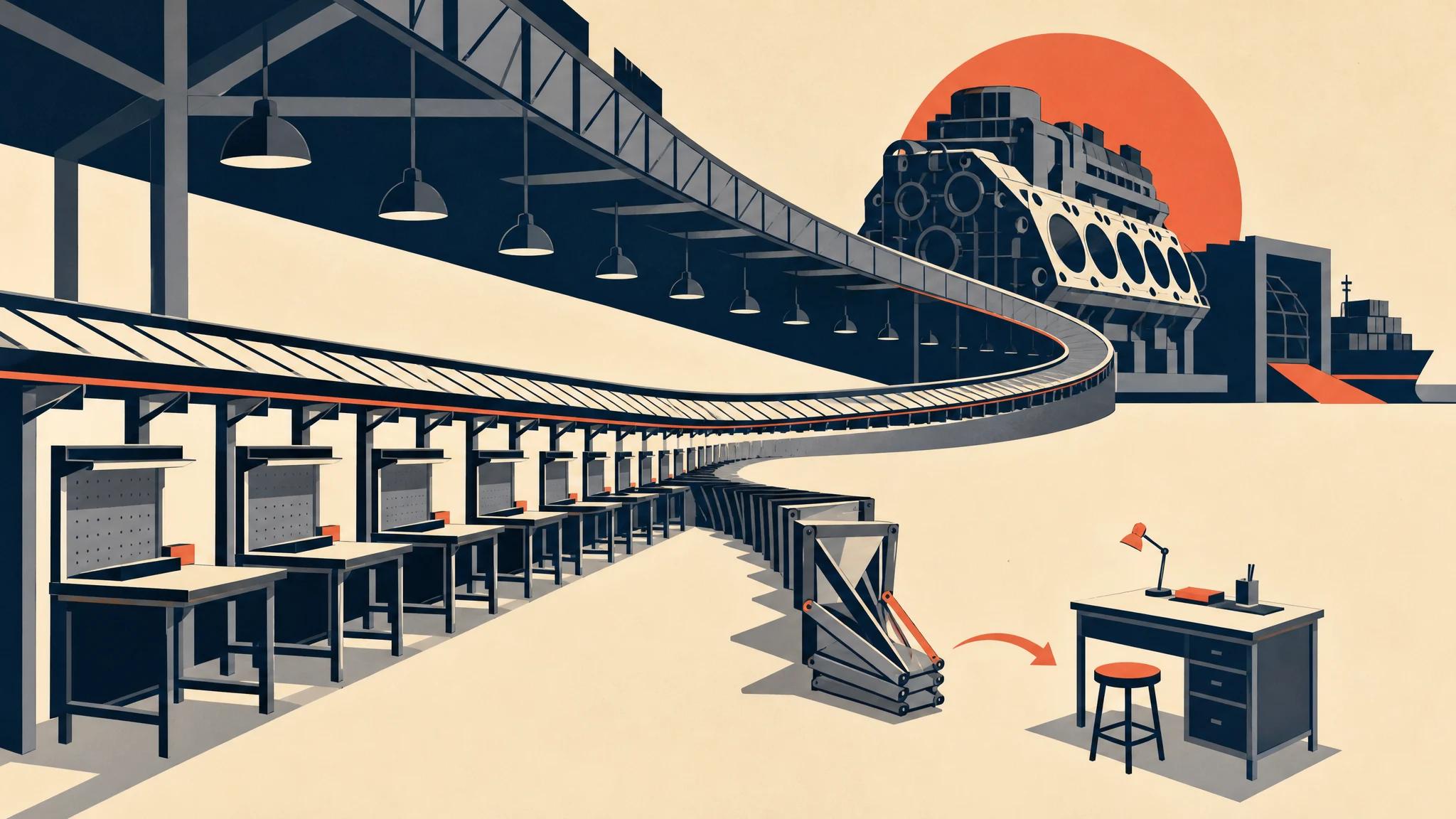
"AI generates game assets for free." Everyone stops there. As if it's just another tool.
But tools don't change industries. What changes industries is which node suddenly disappears. What disappeared in game production isn't the artwork itself. It's the wall of fixed costs that had to be crossed to create that artwork.
History shows convergence has always come this way. When desktop publishing first appeared, people saw it as just "choosing fonts on a computer." What actually happened was the entire nodes of print shops and typesetters getting sucked onto an individual's desk. The distance between distribution and production became zero.
Games stand at the same juncture. In the past, an indie developer had to pass through three gates to release a game: someone to draw, someone to compose, someone to test. These three demanded not money but time and people, and that was the real reason one-person studios were structurally impossible.
Let's refocus on the core. Generative AI is not an 'art generation tool.' It's an event where game production is reorganized into a convergence point of multiple technologies. At least four converge at this point.
First, AI transforms the nodes of art and sound into commodities. The moment you extract concepts with Midjourney and consistent sprite sheets with Stable Diffusion fine-tuning, they're no longer scarce resources.
On top of that, the cloud lends computation. Individuals run models without a single GPU. The capital entry barrier has been fragmented into monthly subscription fees.
And the engine absorbs all of this. Unity and Unreal are no longer just renderers—they've become conveyor belts where AI assets flow in and get assembled into games. Even QA is moving toward agents automatically playing to catch bugs inside the engine.
Finally, Steam opens the exit. The distance to sell what you've made to the entire world has, like desktop publishing, converged to zero.
So the real reason one-person studios became possible isn't "because AI draws pictures." It's because all the nodes of production converged onto one person's desk. Art, computation, assembly, and distribution were each someone's toll, and those toll booths were demolished simultaneously.
Let's reverse-engineer the incentives here. Why are Unity and Unreal so aggressive about AI integration? It's not charity. When the art node becomes free, the profit in the value chain flows to the remaining bottleneck. That bottleneck is the engine. The more prosperous creators become, the narrower and more expensive the toll-collecting position gets. The freer assets become, the greater the power of the conveyor belt.
The emerging economic actors are clear. The margins held by art outsourcing studios and mid-tier production companies split and flow in two directions: toward individual developers on one side, and toward platforms on the other. The middle layer that did the making thins out, while those who sell tools and those who hold the exit take their share.
One strong counterargument: "Isn't this just a common tool innovation with lowered entry barriers? Even if 10,000 more games pour out, most get buried. Calling it structural change is an exaggeration." I'll honestly acknowledge this. When production becomes easier, the bottleneck simply shifts from production to discovery. So the next toll is held by Steam's recommendation algorithm and discovery channels. The node hasn't disappeared—it's moved. That's the key point. The tool innovation isn't the end—the event is where the center of gravity of power has rolled.
Let's plot Korea's coordinates here. On the global adoption curve, Korea stands at the early majority entry point. In a landscape where the U.S. creates tools and China churns out volume, Korea's position is 'what to insert into the space left by collapsed production nodes.' We have proven live operations know-how and mobile monetization design. These are nodes AI hasn't yet turned into commodities.
Look at Busan's indie scene. Busan has already built a channel for small teams to reach global exits through BIC. As AI devours art and QA, the battleground is whether Busan's small teams can reinvest the time they've saved into the new bottlenecks of discovery and operations.
Here's a question for journalists writing game beats tomorrow: When you see a new release, don't ask "Did they make assets with AI?" Ask "Which node did this studio save, and where in the next bottleneck did they pour that saved resource?" That's where the team's survival is written.
One hidden risk: Just because assets became free doesn't mean costs disappeared. Costs have transferred to the gray zone of training data provenance. The real bill for sprites being extracted for free now will arrive on someone's desk later in the form of copyright litigation. The toll hasn't disappeared—the billing date has just been postponed.
The future doesn't come from Midjourney alone, or Unreal alone. It comes from the convergence point where AI, cloud, engine, and distribution overlap on one person's desk. One-person studios aren't a gift of tools. They're the vacancy created as nodes collapse.
This article was automatically translated from the Korean original by AI. For the authoritative version, read it in Korean.
한국어 원문 읽기 →