Who Collects the Toll at the Crossroads
What America is debating over MrBeast isn't about view counts—it's about the crossroads of the creative value chain. Korea is transcribing that debate with an outdated label: 'the agency model.'
AI Summary
While American media critics debate whether MrBeast has transformed from creator to gatekeeper by building platforms that collect data and tolls from other creators, Korean coverage reduces this structural shift to a familiar 'entertainment agency model.' This interpretive gap means Korea is asking the wrong questions—focusing on earnings rather than who controls the crossroads of the creative value chain and owns the data flowing through it.
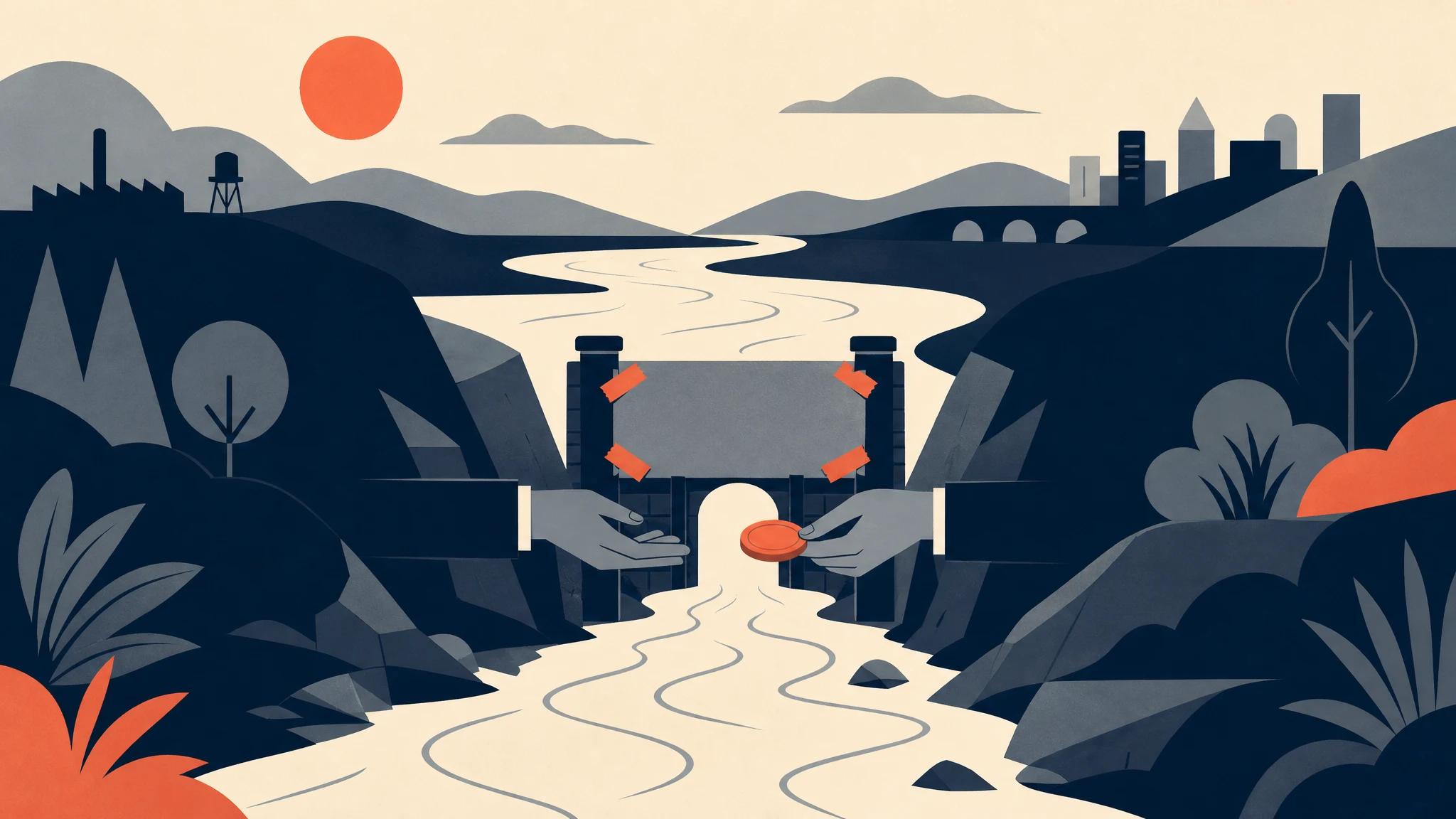
The Real Debate in America
There's a scene that's been repeating in American media criticism since last year. The question people ask about Jimmy Donaldson—that is, MrBeast—is no longer "how does he pull those view counts." The question has changed to this: Is this person a creator or a manufacturer? He's placed his chocolate brand Feastables on Walmart shelves, ran a hamburger business via cloud kitchen model, and it's been a long time since he personally made all the videos uploaded to his channel. Content is stamped out by the factory he built. What he does is closer to placing his face at the very end of the line.
English-language columnists find this scene interesting not because Donaldson personally became rich. It's because he built another platform on top of the platform called YouTube. He's someone who makes content, while also beginning to lay down the crossroads through which other people's content flows. Beast Gaming, Beast Industries, and even ViewStats, a tool company that claims to analyze creators' video performance. The name MrBeast now operates not as one person's channel, but like a small operating system that other creators must climb aboard.
How Korea Misunderstands This Scene
When this news crosses into Korea, the label attached is predetermined. "YouTuber grows business like an entertainment agency." Or "an evolved form of MCN." It's not wrong. But this label is dangerous not because it's wrong, but because it's familiar. Familiar words stop thinking right there.
Read through the agency model lens, MrBeast becomes 'the American version of SM or HYBE.' A company that gathers talented people, sells merchandise, and expands IP. The moment we read it this way, we trap him at the very bottom of the content value chain—in the 'producer' box. No matter how big, the picture is ultimately of a tenant renting space on the platform called YouTube. The question that Korean media almost always omits when covering this beat arises here. When ViewStats, which he created, sucks in other creators' data, whose does that data become? What Beast Industries takes in exchange for providing production costs and know-how to new creators—is it a portion of appearance fees, or the growth curve of that person's channel itself?
The word 'agency' covers up all these questions entirely. An agency ends when its affiliated entertainer leaves, but the structure MrBeast is aiming for is a crossroads where the toll keeps being collected even after they leave. They're completely different animals.
Why He Bothered to Establish Multiple Companies
Reading just the press releases, MrBeast's expansion looks like 'a successful person's diversification.' But when you trace the motivation backward from the structure, a different picture emerges. The fundamental anxiety of a YouTube creator is that the source of revenue is tied to a single thing: the platform's advertising distribution. When YouTube tweaks its algorithm once or ad rates drop once, even the biggest channel's revenue staggers in an instant. What Donaldson did was work to detach himself from this single bottleneck.
Placing chocolate in Walmart amounts to digging one more path to the consumer's wallet without going through YouTube. Creating the analytics tool ViewStats is even cleverer. The moment other creators use that tool wanting to know their channel performance, MrBeast shares in one thing that YouTube had monopolized: the data that reads 'what content will blow up next.' In the content industry, the real asset isn't one video, but the signals that will become input values for the next 100 videos. Data that tells you what creates clicks and what creates dropoffs. Donaldson accumulated more of those signals than anyone in the massive laboratory that is his channel, and now he's trying to sell them to others and hold the industry's meter in his own hands.
This is the fork between making and collecting. While making videos, he was someone who made things. But when he starts installing meters at the crossroads where other people's content flows and collecting tolls, he shifts from maker to collector. This is precisely the point that makes American criticism uncomfortable. It's not to criticize him, but the awareness that they're watching in real-time as one person climbs up the value chain and becomes the gatekeeper of a new crossroads.
A Debate America Has Already Finished, A Debate We Haven't Even Started
This structure isn't just MrBeast's story. In America, similar debates have repeated across industries over the past decade. The process by which Amazon started as a simple shopping mall, watched the sales data of vendor-sellers, copied well-selling items as its own brand, and transformed into a structure that collects tolls in the form of advertising fees and logistics costs from those sellers. The process by which Apple started as a marketplace selling apps and became a gatekeeper charging 30 percent on every payment passing through that marketplace. The question American regulators and columnists threw at these cases was consistent: When a platform starts competing with people doing business on top of it, is that data used fairly? How far can the one who holds the crossroads collect tolls? Where does legitimate business end and rent-seeking begin?
The MrBeast debate is this old question descending to the 'individual creator' level. Before, only giant corporations could lay down crossroads. Now a sufficiently large individual can also lay roads on top of others' creations and become a gatekeeper. America is already deep into debating this change under the framework of 'vertical integration of the creator economy.' They also look at where trust shifts from whom to whom. Viewer trust accumulates not on the platform called YouTube but on the face called Donaldson, and that trust gets converted into chocolate, hamburgers, and analytics tools. Who owns the trust exchange—that's the true position of power.
Here we must address one honest counterargument. All of this could be over-interpretation. The counterargument that Donaldson is just a person with good business sense, establishing multiple companies is just ordinary diversification that rich people always do, and structural analysis about gatekeepers and tolls is applying a grandiose lens to ordinary affairs. Half of that is correct. If ViewStats fails to capture the market and disappears, this analysis becomes a phantom. However, the value of the structural lens lies not in prophecy but in questions. Whether he succeeds or fails, the question 'what happens when an individual tries to seize the crossroads of the creative value chain' remains valid. The standard that determines whether it ends as ordinary diversification or the birth of a new gatekeeper is just one thing: has the tool he created started running on others' data? That line has already been crossed.
What Korea Is Late On Isn't Technology, It's Questions
This scene becomes clearer when viewed from Busan. Korea also has major creators and MCNs, and merchandise and IP expansion are active. But the frame Korean media uses when covering them still remains stuck on 'an extension of the entertainment industry.' Who earned how much, what merchandise sold out. They diligently follow surface-level performance, but the beat that asks who's laying the crossroads underneath and who's holding the data is almost empty.
This isn't because we're late to receive the technology. It's because we're late to receive the questions. When America debates 'is this a creator or a manufacturer,' Korea stays at 'so what's that YouTuber's salary anyway?' Looking at the same event, one side reads the reorganization of the value chain, the other reads entertainment gossip. When that difference accumulates, when identical vertical integration happens in Korea's creator industry, we won't have the language to analyze it. The day a major Korean creator starts selling analytics tools by gathering junior creators' channel data, we're likely to read it as 'a kind senior sharing know-how.' The very scene America already read as 'the birth of a gatekeeper.'
If a Korean reporter takes on this beat tomorrow, one question is enough. Is the new company this creator established for making their own content better, or for installing a meter at the crossroads where other people's content flows? If the latter, whose is the data that accumulates in that meter, and who pays the toll and who collects it? Just carrying these two questions will make the worn label 'agency model' fall off by itself.
Ultimately, the problem is interpretive sovereignty. Who first names an event dominates the way that event is understood for a long time. America attached the name 'vertical integration of the value chain' to one person named MrBeast's expansion, and with that name is shaping the language of regulation, criticism, and the market. The moment Korea transcribes it as 'agency model,' we're not belatedly copying a problem others have solved—we're transcribing the problem incorrectly. What Korea imports late isn't just technology. Sometimes we import the questions themselves late, and with wrong translations at that.
This article was automatically translated from the Korean original by AI. For the authoritative version, read it in Korean.
한국어 원문 읽기 →