We Cry to Lyrics Written by AI
In 2026, AI-composed songs that chart provoke real emotions. The authenticity of art is being redefined not by 'who wrote it' but by 'why we respond to it.' As authorship wavers, what remains for humans to do?
AI Summary
As AI-generated music enters streaming charts and triggers genuine emotional responses in 2026, the traditional concept of artistic authenticity—rooted in human authorship and lived experience—is being fundamentally challenged. Cognitive science suggests emotional impact originates in the listener rather than the creator, meaning AI can replicate emotional effects without experiencing emotion itself. The crucial question shifts from whether machines can create moving art to what humans will reserve as distinctly human work: curation, contextualization, intentionality, and accountability for creative choices.
When tears don't ask about origins
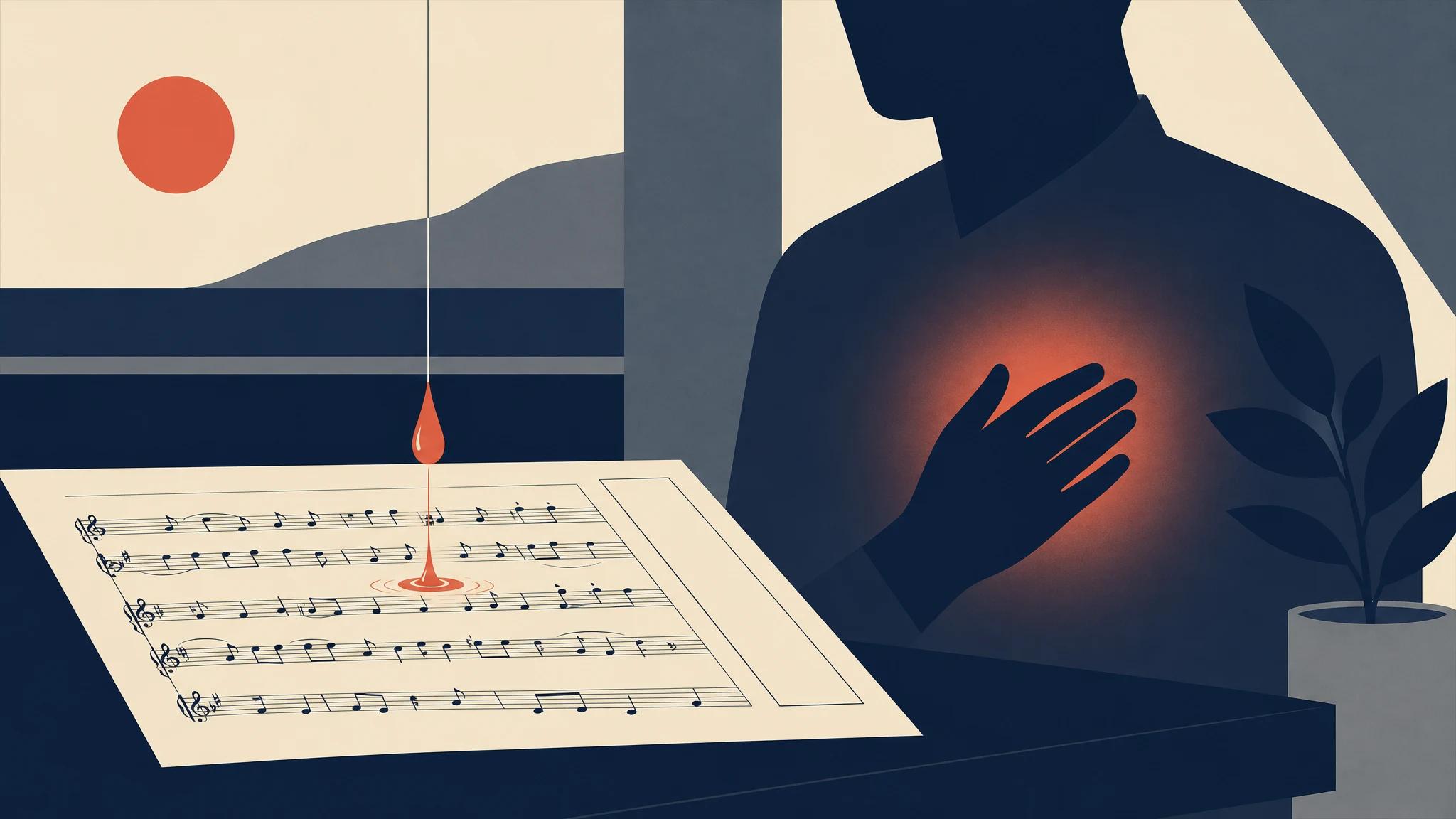
A listener cries while hearing a ballad. Because the breakup in the lyrics feels like their own story, because the melody of the chorus precisely presses somewhere in their chest. Then they later find out. That song wasn't written by a person. The melody, the lyrics, even the trembling of the voice were all created by a model. What happens to the tears already shed? Should they be taken back as fake tears?
The music market of 2026 has turned this question from abstraction into reality. Songs created by AI appear on streaming charts, get added to playlists without anyone knowing their identity, and play as background music for someone's commute, funeral, or confession. In Korea too, tracks made with AI vocals and composition tools circulate between Melon and YouTube Music. What's interesting isn't the quality of the songs. It's the fact that people genuinely respond when they don't know the source.
For a long time, we tied artistic authenticity to the origin of 'a human sincerely experiencing and writing it.' We believed sad songs were sad because the composer was actually sad. But models precisely reproduce the form of sadness without experiencing anyone's sadness. They create the effect of emotion without an original emotion. What wavers at this point is not AI's capability but our old concept of 'authorship.'
Emotional response occurs not in the source but within the receiver
Objectively speaking, emotion has never been contained within a song. Sound waves are merely vibrations in air, and meaning is created by the listener's brain. According to cognitive science's predictive processing model, we constantly predict the next note, and when that prediction is appropriately betrayed and resolved, we feel pleasure and thrills. The chord progression of sadness, the position where the voice cracks, the space the lyrics leave empty with silence. These are 'buttons' aimed at the human listener's nervous system, and models have learned the arrangement of those buttons from hundreds of millions of songs' worth of data.
So authenticity was never an attribute of the song from the start—it was an event. An event that occurs between the listener and the sound. The composer's sincerity was merely one of several pathways that trigger that event, not the only pathway. We cry at a dead poet's verses and break down at a singer's song we've never met, not because we directly access their sincerity, but because the work touches something within us. The source is distant, and the response has always been here, within the receiver.
Here comes a counterargument. That human-made songs still have a 'weight of actual experience' that models can never possess, and knowing this changes the quality of emotion. This is true. Once you know the source, the same song sounds different. But this isn't because the song changed—it's because the context we assign to it changed. We retrospectively give different names to the same tears. If we believe it's sincere, it becomes a tribute; if we know it's machine-made, we feel deceived. This counterargument actually proves that what judges authenticity isn't the work itself but the narrative we construct around it.
Redefining human roles where authorship has dispersed
Viewing the problem through the lens of model performance leads to a dead end. All that remains is an arms race of who makes songs that make people cry better. The real transformation lies in redefining human roles. When composition becomes a generative act anyone can engage in, value shifts from 'the ability to create sound' to elsewhere. Curation that selects what to present, editing that gives context and story to a song, intention that determines whose moment and which person's life this music should reach. The more common production becomes, the scarcer judgment and responsibility become.
This change doesn't stop at music. In labor, what remains is not 'the hands that create output' but 'the head that decides what to create and takes responsibility for the results.' In education, rather than transmitting compositional techniques, the core becomes critical sensibility that deconstructs and evaluates why this work moves people. In organizations, as AI pours out drafts, gatekeeping—deciding which of those drafts to release to the world—becomes the most human work. What's been externalized is generation; what's left for humans is choice and bearing that choice.
Korean society is both particularly vulnerable and advantageous for this transition. The K-pop industry long ago dismantled the 'single genius author' myth through songwriting camps and division-of-labor producing. Dozens of names go on a single track. So we're accustomed to production structures where authorship is dispersed. For solo creators making music in Busan, AI could become either a tool to compete with Seoul's large songwriting camps or a flood that erases their own voice. The crossroads depends not on the tool's performance but on how we design systems for creators' rights, source attribution, and consent for data training. Copyright must shift its question from 'who arranged the notes' to 'who intended and takes responsibility.'
What to preserve as human work
The question of whether machines can create songs that cry like humans has already been answered. They do. And they genuinely make us cry. Then the remaining question has a different direction. What will we preserve as human work?
We can hand over the work of arranging sounds. But judging which sadness is worth releasing to the world, hoping a song will reach someone's wound and taking responsibility for that result, deciding together what name to give to the tears shed—these remain human tasks. The real news of an era when we cry to AI-written lyrics isn't that machines have acquired souls. It's that souls were on the listener's side from the beginning, and now, facing that fact, we must decide for ourselves what we will keep firmly in human hands until the end.
This article was automatically translated from the Korean original by AI. For the authoritative version, read it in Korean.
한국어 원문 읽기 →