When Only Review Remains, Who Takes Responsibility?
AI doesn't remove entire jobs. While it reduces a 5-minute repetition to 30 seconds, judgment disappears from creation and only review remains. So where does responsibility go?
AI Summary
As AI automates the creation and decision-making steps of work—from accounting entries to call center responses—human workers are increasingly relegated to mere reviewers who approve outputs they didn't create and don't fully understand. This shift creates a dangerous asymmetry where authority resides in systems but responsibility remains with individuals who lack the materials, time, and training to exercise meaningful judgment. Korea's challenge is not building smarter models but redesigning work structures that preserve human judgment, ensure adequate review conditions, and clarify accountability in AI-assisted workflows.
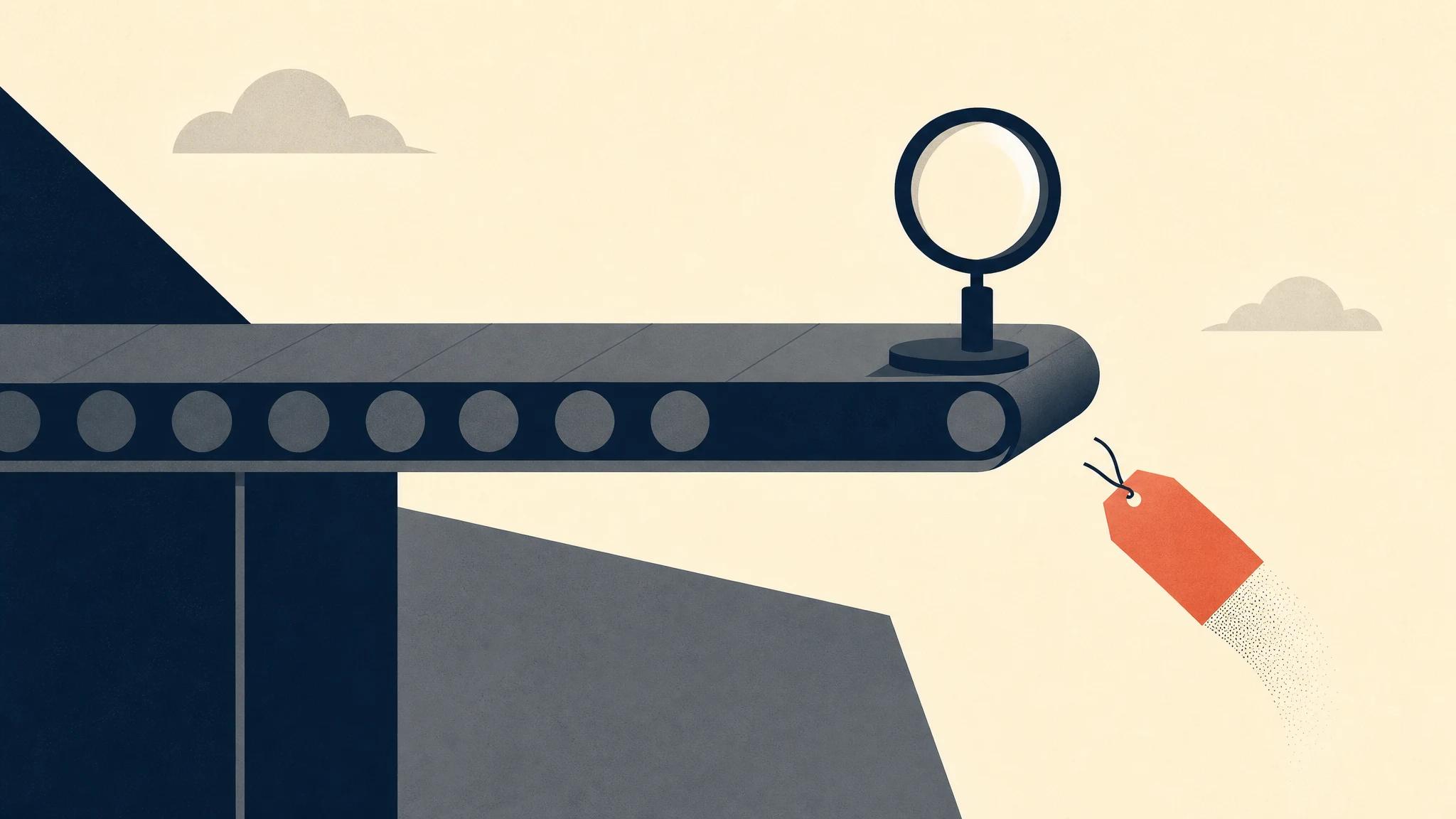
Where Did the Mind Go on the Day Hands Got Faster?
Imagine a junior accountant on an accounting team entering journal entries. In the past, they looked at each receipt and selected the account category. Was it a meal expense or welfare benefit? Entertainment or meeting expense? That 5-minute deliberation was the substance of accounting. Now, they photograph and upload the receipt, the model recommends the account category and fills in the amount. All the junior does is look at the result on screen and press the approval button. It's done in 30 seconds.
On the surface, productivity has increased tenfold. But when you look at what disappeared, the story changes. What disappeared wasn't time. It was the small judgment that occurred in the junior's mind while directly selecting account categories, the act of asking anew each time what this expenditure means in the company's books. Now the junior doesn't create. They look. Judgment has disappeared from creation, leaving only review.
If you dismiss this as simply making work easier, you miss the core issue. What humans have long believed to be their unique domain was not the speed of muscles but the judgment made anew for each matter. Machines lifted heavy things and calculators added quickly, but deciding what to put in which account was a human task. AI has risen to precisely that last bastion, the layer that reads context, classifies, and decides. In doing so, it has shifted the center of gravity of work from creation to review.
AI Removes Segments
Here we must address a common misconception. The fear that AI will completely eliminate jobs. Stories like accountants will disappear, lawyers will disappear. What's actually happening is not that simple. Occupations are not single lumps but bundles of multiple tasks, and AI selectively removes only specific segments from within those bundles.
It becomes clear when you view tasks as a value chain. Processing a single accounting transaction has segments: receipt reading, account classification, amount entry, anomaly review, and final approval. Previously, these segments flowed seamlessly within one person's mind. While reading, they thought about classification; while classifying, they detected anomalies. Because the segments were connected, judgment flowed. What AI did was detach the front segments like standard parts and take them to its side. Reading, classification, and entry became modules that entered the model. The segments remaining for humans are at the very end: review and approval.
The problem is the disconnection created where segments were removed. When the front segments bypass the human mind and only throw out results, the reviewer must judge right from wrong without knowing what reasoning produced that result. Approving what you didn't create is qualitatively different from checking what you created. The person who created it knows where the weaknesses are. The person who receives it has no clues to suspect the plausible surface. This is the trap of review. Speed increases but the density of review decreases. Hands that pass quickly cannot suspect slowly.
Looking at call centers, this change has already completed one cycle. Agents don't compose responses. They select and send response phrases recommended by the model. On good days, response time decreases and satisfaction rises. On bad days, subtle errors in recommended phrases go straight to customers. Agents have become people who let things pass, not people who create. When something goes wrong, is the responsibility with the model that recommended or the person who let it pass?
Don't Ask About Performance—Redraw the Roles
There's a point where discussion often gets stuck. Endless disputes about how accurate the model is. Is 95 percent accuracy enough, or does it need to be 99 percent? This question is important too, but it's not the essence. The essence is where to redraw human roles.
No matter how much accuracy increases, as long as it's not 100 percent, someone takes responsibility at the end. And paradoxically, the higher the accuracy, the more dangerous review becomes. In front of a system that gets only one in a hundred wrong, reviewers begin to doze. Ninety-nine were right, so the hundredth will be too. The old warning that autonomous driving is more dangerous in the partial automation stage is precisely this structure. A person who neither releases nor grabs the steering wheel but only watches the screen cannot react in the critical 0.5 seconds when intervention is needed. It's a design that positions humans as a safety device while removing the conditions for humans to operate.
So we must change the question. Not how well the model does the work, but how we design work so people do what. If you don't give materials for judgment to people left with only review, those people degenerate into rubber stamps. Stamps cannot take responsibility. But when accidents happen, organizations look for the hand that stamped. Authority is with the system and responsibility remains with people—an asymmetry is created.
Here we must honestly face the strongest counterargument. Isn't this just a form of division of labor that has always existed? Factory workers also assembled parts they didn't design, and editors also refined writing they didn't produce. Review is work humanity has long done. That's correct. But there's a difference. Past reviewers knew the creation process. Editors could write, and assembly workers knew the purpose of parts. What's new about AI review is that reviewers gradually lose production capacity while retaining only responsibility. People who don't know how to create judge what was created. This combination of incompetence and responsibility is what differs from past division of labor.
Education and Organizations Must Preserve Creation Capacity
If this diagnosis is correct, labor, education, and organizational design are all shaken simultaneously.
In labor, the path of skill acquisition is severed. When those 5 minutes in which a junior directly entered journal entries and learned the feel of accounting disappear, the path for them to become skilled reviewers in 10 years also disappears. Only people who have created can properly review. But if AI takes away the work of creation, where will the next generation of reviewers be cultivated? Organizations gain immediate speed in exchange for eroding future judgment capacity. It's a slowly progressing erosion of capital. It's more dangerous because it's not recorded as a cost in the books.
Education must move away from training to produce correct answers quickly. Korean education has long cultivated fast and accurate processing. That capacity is now the segment that becomes a module and falls away first. What remains as human work is suspecting plausible answers the model produces, catching errors outside context, and questioning what should have been the question to ask in the first place. Because these are abilities difficult to grade, they're the domain Korean education has taught worst.
In organizations, the responsibility structure must be redesigned. A design that gives reviewers only an approval button while imposing responsibility is a design waiting for accidents. People who approve must be able to look into the reasoning process, time to doubt must be guaranteed, and there must be no disadvantage when they refuse. Reviewers evaluated by pass-through rates will inevitably only let things pass. It's not laziness but the operation of incentives. It's not a matter of blaming morals but fixing structure.
From Busan, Where Are Korea's Coordinates?
Looking globally, Korea is at an interesting position on this curve. It's ahead in rapidly bringing in automation tools. AI assistance is quickly spreading to accounting, legal, call centers, and medical diagnostics. However, it's far behind in redesigning responsibility structures and institutional design that guarantees reviewers' authority and time. Tools come in at developed-country speed but safety devices don't keep up. It's a dangerous time lag—fast adoption, slow governance.
In the field of small and medium enterprises in cities like Busan, this time lag widens further. Large corporations at least have audit and control departments, but in small organizations with thin staffing, when AI enters positions where one person handled both creation and review, even review becomes perfunctory. Only people to let things pass remain, and there's no one to suspect. When accidents explode, that one person takes all responsibility. The thinner the capital and personnel, the harsher this asymmetry.
What Korea needs to prepare is not smarter models. Those can be purchased. What needs preparation is the design capacity to decide at which segment of work to leave human judgment. Which decisions will we keep having people create to the end? What will we show reviewers and how much time will we give them? How will we protect the authority to refuse? Organizations that answer these questions will take the trust of the next 10 years.
The question to give reporters covering the same beat tomorrow is simple. When a company announces AI adoption, don't ask what was automated—ask who takes responsibility at the end. Ask whether that person can see the reasoning process of results, whether they have time and authority to refuse, whether they're evaluated by pass-through rates. If the answer is vague, that company bought speed and created a place to shift responsibility.
Ultimately, the question of the AI era is not whether machines will become like humans. It's what humans will leave as human work. Hands that have handed over all creation and hold only review become as powerless as they've become faster. Deciding what we will create with our own hands to the end—that is the most human judgment remaining now.
This article was automatically translated from the Korean original by AI. For the authoritative version, read it in Korean.
한국어 원문 읽기 →