The Price of What Cannot Be Copied
In 2026, models train on human output to teach humans. Anger is easy. The harder question is what still remains outside the model.
AI Summary
The article argues that while AI models can replicate human outputs — text, images, code — they cannot capture the judgment, context, and accountability embedded in the act of creation. The author contends that the true value of human labor is shifting from producing outputs to deciding which outputs are right and worthy of release. South Korea, the piece warns, must learn to recognize and price this irreplicable human capacity before it disappears unnoticed.
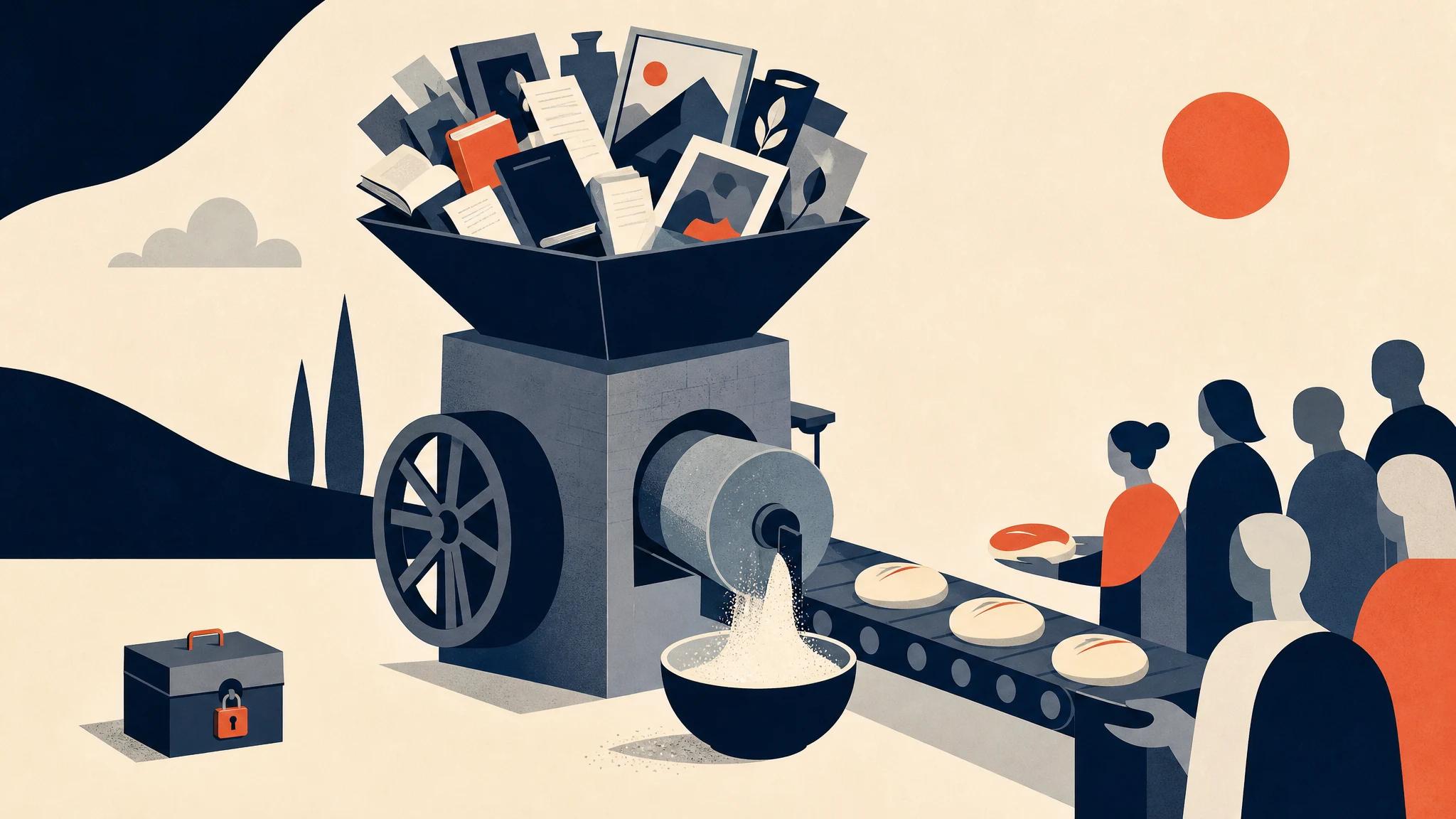
A copywriter received their own sentences back from a chatbot, nearly verbatim. No attribution, no name. They were angry — but the feeling that lingered longest was something else entirely. So this was me. The craft I spent a lifetime honing, compressed into a single line of training data.
This is the landscape of 2026. Models absorb and train on text, images, and code created by humans — and now even the synthetic data generated by models themselves is fed back in as raw material. They copy from humans to teach humans, then copy the copies to teach again.
The common reaction is anger. The phrase 'second-order extraction' gets thrown around — the idea that the fruits of one's labor have become someone else's capital without consent. It is righteous anger. But anger cannot draw the boundary.
Anger asks: who took it? The question I want to ask is different. What, in the end, cannot be taken?
Consider this. What models train on is output. Finished sentences, completed illustrations, merged code. The surface of results. But most of what a person does to arrive at that result is never written into the output.
The sentences you chose not to write aren't in the data. The reason you rewrote something three times isn't there. The moment you read a client's expression and pivoted — that isn't there either. Models learn from what we kept, not what we discarded. Yet judgment is the sum of everything we threw away.
The boundary, then, is drawn between output and context. What can be copied is the output. What cannot easily be copied is the capacity to know whether that output fits this situation.
Look at medicine. Reports are piling up that diagnostic models have caught up with specialists in reading medical images. But the order in which to deliver bad news to a patient, the silences to leave between words — none of that is in the data. That is not output. It is relationship.
Look at law. Models are already faster at summarizing precedents. But deciding whether this case should be an exception to those precedents is not a matter of text — it is a matter of the person who stands accountable for that decision. Accountability cannot be outsourced. Without a subject who bears responsibility, what you have is not judgment but output.
Here the last moat of human labor reveals itself. Context, accountability, presence. Models know the average. Humans know this particular case. Models know what is usually right. Humans know who, here and now, will bear the consequences.
So how is work being redefined? It shifts from labor that produces output to labor that judges whether the output is right — and takes responsibility for that judgment. From the person who makes, to the person who finalizes. Value moves from generation to verification and decision.
Education is shaken at this point. We have long cultivated the ability to produce correct answers quickly. But that is now what models do best. What remains for education is the sense to recognize when an output is wrong. The training to know what must be discarded.
Organizations change, too. Structures that evaluated people by volume of output will collapse. In a world where models can generate unlimited quantity, the human role is to responsibly select which of that quantity gets released. Toward making less and taking deeper responsibility.
Is Korea ready? Think of a small- or mid-sized manufacturing floor in Busan. The model knows the manual perfectly. But why this machine sounds different today than usual — that lives in the fingertips of the person who has worked it for twenty years. Those fingertips have never been digitized. Our society must reappraise them not as objects of protection but as assets. We must put a price on labor that cannot be copied.
The counterargument is sharp. Context, accountability — once accumulated as data, they too will enter the model. It is only a matter of time, the argument goes. There is truth in it. Yesterday's frontline gets trained on today. But the moat lies not in any specific skill — it lies in time itself. Models know up to yesterday. Accountability is always owed to tomorrow. By the time learning catches up, human work has already moved to the next frontier.
So let us change the question. Whether machines will become like humans is an interesting but idle question. The real question is this: what will we ultimately keep as human work? Models take what we have made. There is no reason to also hand over the decisions about what to make and whether to release it. What cannot be copied is not the answer — it is the person who stands accountable for the answer.
This article was automatically translated from the Korean original by AI. For the authoritative version, read it in Korean.
한국어 원문 읽기 →