Who Bears the Error?
The AI copilot that has entered the workplace is no longer just a tool — it has become a colleague with whom trust must be negotiated. That trust is not built on accuracy rates but on the rules for sharing accountability when something goes wrong. In Korea's hierarchical organizations, those rules remain unwritten, and the empty space invariably flows downward.
AI Summary
AI copilots have quietly shifted from tools to de facto colleagues in the modern office, yet no institutional rules exist for distributing accountability when they fail. Vendors engineer their products to invite trust while contractually offloading liability to users, and in Korea's steep hierarchies this means errors reliably roll down to the most junior staff. Building genuine trust in AI, the article argues, requires not better accuracy benchmarks but explicit frameworks that assign responsibility to those who authorized the technology — not to whoever last touched the keyboard.
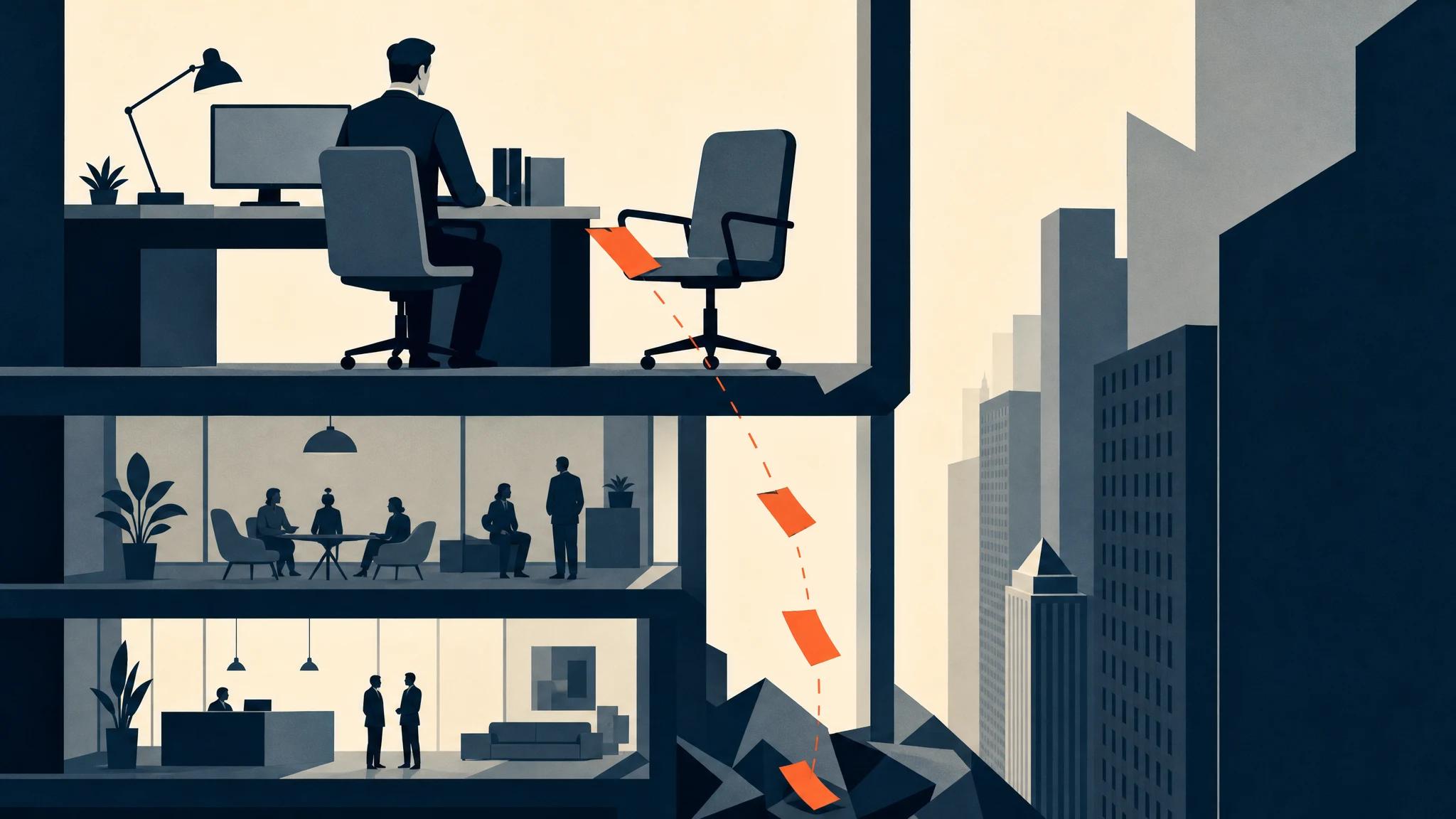
The Fourth Chair in the Conference Room
A familiar scene in today's offices: the copilot drafts the report and the human reviews it. When autocomplete fills in half the code, the developer accepts or rejects. Marketing copy, contract summaries, interview shortlists — an invisible colleague pitches in. Everyone calls this efficiency. Time has been saved, after all.
Yet the word efficiency obscures something. The way people handle this software has drifted closer to how they handle a colleague than a tool. You don't trust a hammer — it either works or it doesn't. But in front of a copilot, you hesitate. Can I trust this answer? How much can I safely delegate? Trust — that variable organizational psychologists have long measured between human coworkers — has suddenly migrated into the space between person and machine.
Trust is not the same as accuracy. We trust a colleague not because they have never been wrong, but because we can predict what happens when they are. The unspoken contract: mistakes aren't hidden, accountability is clear, and losses are shared. An AI colleague has none of those rules. So the real question is this: when the machine is wrong, who absorbs the cost?
The Accuracy Trap
Vendors sell trust through accuracy figures — percentage correct, hallucination rate. The numbers are tidy but miss the point. A colleague who flags their own errors and shares responsibility is more trustworthy than one who is right ninety percent of the time. The center of gravity for trust lies not in average performance but in how failure is handled.
This is where the asymmetry of power becomes visible. The companies that build copilots transfer responsibility for outcomes to the user in their terms of service: outputs are for reference, and final judgment is yours. Yet the product interface sends the opposite message — delivering answers confidently, in seamless prose, as though no review were necessary. One side seduces you into trusting; the other buries in the contract that the cost of that trust is yours to bear. The contradiction is not accidental. It is a design: stimulate trust to drive adoption, push the cost of failure into the fine print. Efficiency collects at the top; risk disperses downward.
At the level of data, the picture sharpens further. The questions employees put to a copilot carry within them a company's ways of working, customer information, and half-formed ideas. That flow typically passes through the servers of an external model provider. The products of labor become training material; control transfers to the platform. Most users have never negotiated what they surrender in exchange for the convenience.
How Hierarchy Rolls the Error Downhill
In Korean organizations, this problem carries an extra layer of weight. In steeply hierarchical structures, accountability rarely travels upward. The moment a department head says "use AI to pull this together quickly," it is those above who chose the tool and who pressured staff to cut verification time. But when an error slips into the output and an incident results, the most junior person who last touched the keyboard becomes the owner of that output. Decision authority at the top; accountability assigned at the bottom. AI lubricates this long-established tilt.
A counterargument is possible: since a human performs the final review, isn't it fair to hold that person responsible for failing to catch the mistake? Clean logic — but it misreads how things actually work. Copilots mass-produce plausibility. Correct and incorrect answers arrive in the same register, with the same confidence. The time available for review actually shrinks under pressure to demonstrate the ROI of the tool's adoption. Demanding fast, high-volume output while requiring that nothing be missed is, in effect, a mechanism that redefines failure as individual carelessness. Whether a white-collar worker at a mid-sized Busan manufacturer or a junior employee at a Seoul startup, they are handed the same order: use your diligence as a dam against risks the system has offloaded onto you.
By Whose Rules Shall It Operate?
This is not a call to stop the technology. AI colleagues clearly lighten the load. The problem is whose rules this colleague operates by. Right now, vendor terms of service and organizational inertia serve as the rulebook. Both are aligned to channel costs toward the weakest position.
A different design is needed. First, an interface that surfaces sources and evidence so that a reviewer can see where to be skeptical — products that sell only confidence multiply the cost of failure. Second, organizational policies that document AI use and the division of verification responsibility in writing. If it is recorded who designated the tool and who agreed to verify which parts, accountability flows to the decision-maker, not to whoever last touched the keyboard. Third, data boundaries that prevent work inputs from being used for external model training, and users' right to confirm that those boundaries hold. This is where Korea's Personal Information Protection Commission and labor authorities have work to do — not only the freedom to use AI, but the rules that determine where the cost of its errors lands.
Trust is not a feeling — it is an institution. The reason we could trust human colleagues is that society had laid down rules for sharing responsibility when mistakes were made. AI colleagues do not yet have those rules. So the question worth asking is not whether we can trust this machine. It is: when this machine is wrong, who do we decide will pay the price? Trust does not come from accuracy. It comes from the distribution of accountability. Whether we leave that distribution to vendors and hierarchy, or write it ourselves — that is the choice that remains, for now, blank.
This article was automatically translated from the Korean original by AI. For the authoritative version, read it in Korean.
한국어 원문 읽기 →