The Age of Borrowed Memory
When ultra-long context windows and persistent memory become the standard, memory no longer accumulates in our minds — it accumulates outside the system. The moment that outsourced memory becomes an asset, who owns it, how it is transferred, and when it is deleted emerge as new digital rights.
AI Summary
As long-context AI windows and persistent memory become standard, human memory is being systematically outsourced to external systems — a shift with clear historical precedent in writing, double-entry bookkeeping, and search engines. This outsourced memory is poised to become a new class of digital asset, intersecting with healthcare, mobility, education, and Web3 data ownership to give rise to entirely new economic actors, including what the article terms "cognitive trustees." The central argument is that the most consequential question is not who builds the models, but who writes the rules governing memory ownership, portability, and the right to be forgotten — a domain where Korea, and Busan in particular, may hold a meaningful first-mover advantage.
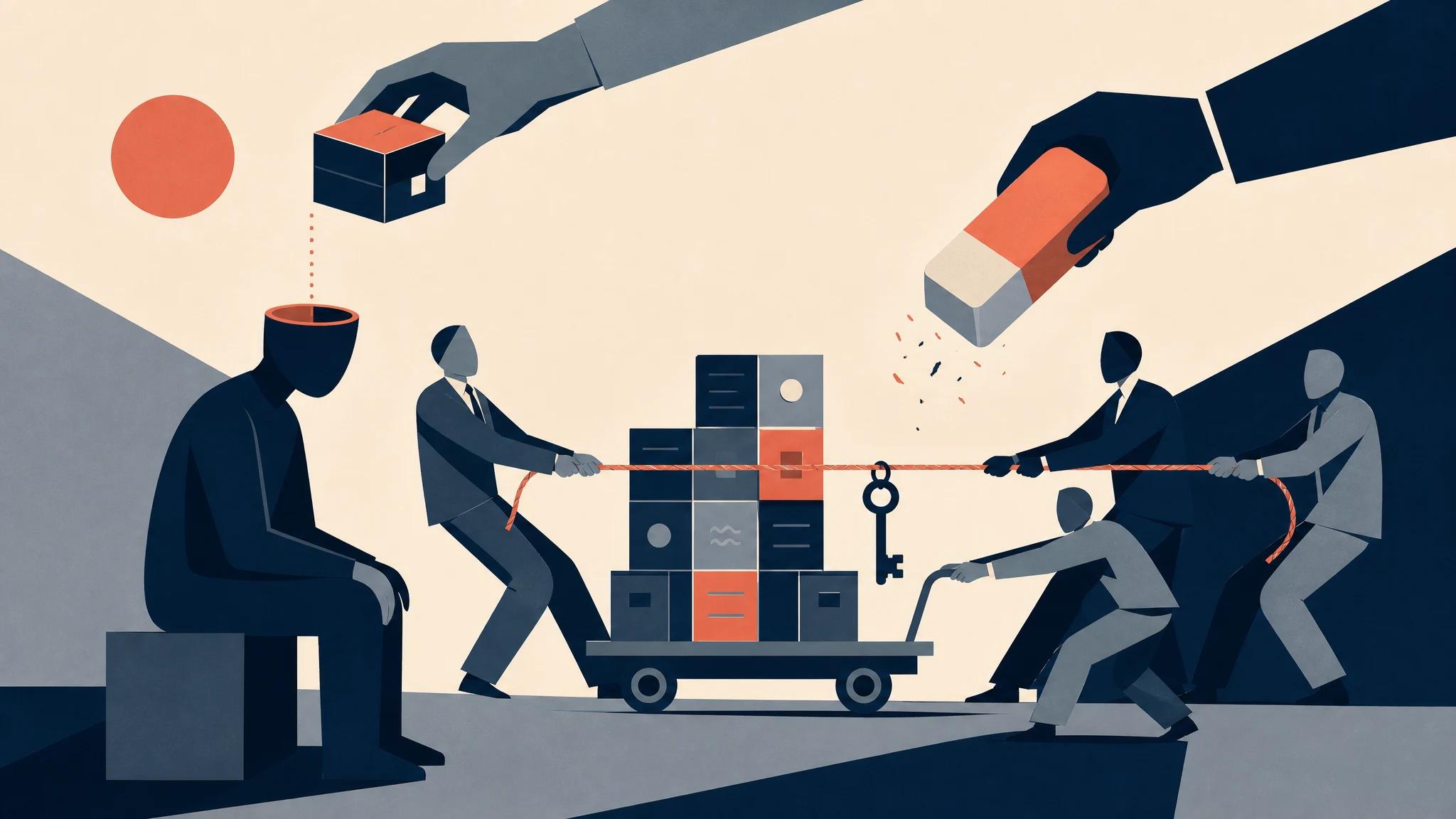
People tend to think of long context windows as simply a feature that lets them "read more at once" — a convenience for pasting in an entire book or summarizing hundreds of PDF pages in one go. That is a narrow reading. When context windows grow and persistent memory is layered on top, what changes is not throughput but the location of memory itself. Your schedule, your speech patterns, the decisions you made last year, the expressions you said you disliked — all of this begins to accumulate not in your own mind but in some storage layer outside the model. It is the outsourcing of memory. And outsourced memory does not remain a peripheral feature of a tool; it becomes an asset in its own right.
Outsourced Memory Has Always Transformed Industries
This is not the first time. Every time humans have entrusted memory to an external medium, one dimension of cognition has atrophied while another has been set free. When writing emerged, the capacity for oral recitation declined, but legal codes, accounting, and science became possible. Double-entry bookkeeping moved the merchant's internal ledger onto a structured paper form, and that structure gave birth to new economic actors — the bank and the joint-stock company. When search engines arrived, we stopped memorizing facts and began remembering "where to look for them" instead. Psychologists call this the Google Effect.
| Outsourced Memory | What Atrophied / What Was Unlocked | |
|---|---|---|
| Writing | Decline of oral memorization | Law codes · Accounting · Science |
| Double-Entry Bookkeeping | Mental ledger | Banks · Joint-stock companies |
| Search Engines | Fact memorization | Remembering 'where to find it' |
The crucial point is that atrophy and liberation always arrived together. Paper replaced memorization but unlocked reasoning. The outsourcing of memory is not a loss — it is an exchange. What context windows and memory are doing today is the next iteration of that same exchange. The difference this time is that what moves outside is not facts but context: the accumulated texture of who I am as a person. That is why the stakes are higher.
Memory Does Not Become an Asset Alone
Here is the Nova question: what other technologies does this one combine with? Persistent memory, on its own, is little more than a longer cache. To become an asset, it must meet other technologies.
Healthcare is first. When continuous glucose monitors, sleep trackers, and medication logs accumulate in a model's long-term memory, they become a living health context that transcends the medical record. Next comes mobility and robotics. For a home robot or a vehicle to remember "what this person asked for yesterday," there must be person-level, portable memory that can travel with the individual. Education is another frontier. Lifelong learning can only trace a genuinely personalized curve when six years of a learner's wrong answers and interests are stored in a single place. And all of this converges with a problem Web3 has long wrestled with: the ownership and portability of data. Can memory, like a wallet holding tokens, follow a person across platforms?
The conclusion of these connections is simple. Memory becomes infrastructure, and the moment it becomes infrastructure, it becomes an object of rights.
New Economic Actors Created by Memory Rights
When these elements combine, what new economic actors emerge? When data becomes an asset, the professions and institutions to manage that asset follow. Just as credit gave rise to credit rating agencies, personal context will give rise to intermediaries who store, verify, and port memory. A kind of cognitive trustee — an entity that decides on your behalf which model to lend your memory to, and what it should be made to forget.
At this point, new rights divide into three branches. Ownership: is my accumulated context a platform asset or my own? Portability: can the data portability right codified in the GDPR be applied to model memory — can "me" as accumulated inside OpenAI be moved to another model? Deletion: does the right to be forgotten extend beyond the search index into a model's long-term memory? The EU AI Act and Korea's Personal Information Protection Act address data, but the form of context dissolved into a model remains a legal blind spot.
Counterarguments exist. Memory is scattered across model weights, technically difficult to extract and transfer wholesale, and will ultimately end up locked inside giant platforms — so the objection goes. It is a fair point. Yet history has moved the other way. Number portability broke telecom lock-in; open banking opened up accounts. The technical difficulty of portability has never stopped the legislative enshrinement of portability rights. If anything, it is precisely because the task is difficult that it gets nailed down as a right.
Busan and Korea's Position
Korea holds surprisingly strong cards at this convergence point. It is one of the few countries to have piloted a MyData framework in the financial sector first, and to have experimented with personal information portability in public administration. Memory portability rights, read as the next chapter of MyData, are not a particularly unfamiliar problem. Busan, positioned at the confluence of data centers and submarine cables, has the coordinates to build custodial infrastructure — the kind that safely stores and transfers memory as a heavy, high-value asset — into a regional industry. If we are a step behind in the race to build models, we can enter from the angle of who protects and moves "me as remembered by the model," and who writes those rules first.
Where is the point that looks small today but will become infrastructure tomorrow? It is precisely these protocols for memory custody and portability. If it is unsettling to think that context windows may replace human memory, it is more unsettling still to leave the question of who owns that replacement unanswered. The future does not arrive from a single, longer context window. It comes from the intersection where memory meets healthcare, mobility, education, and the rules of ownership.
This article was automatically translated from the Korean original by AI. For the authoritative version, read it in Korean.
한국어 원문 읽기 →