The Cost of Proving the Real
In an age when AI churns out text without limit, the real bill is not what it costs to stop fakes. It is the labor of proving that something genuine is genuine. Who absorbs this verification tax will draw the new power map of the information environment.
AI Summary
The article argues that while AI has driven content-generation costs toward zero, the burden of verification has been silently transferred to readers, professionals, and institutions — a 'verification tax' paid by information consumers rather than producers, mirroring Brandolini's Law at industrial scale. Verified authorship and source accountability are becoming scarce commodities as platforms and model-training pipelines mine human-produced truth for free. The piece calls for regulatory redesign — particularly in Korea — that makes producers bear provenance costs, and argues that AI-native media will ultimately strengthen rather than replace the human publisher willing to stake their name on what they print.
The Scene We Call Efficiency
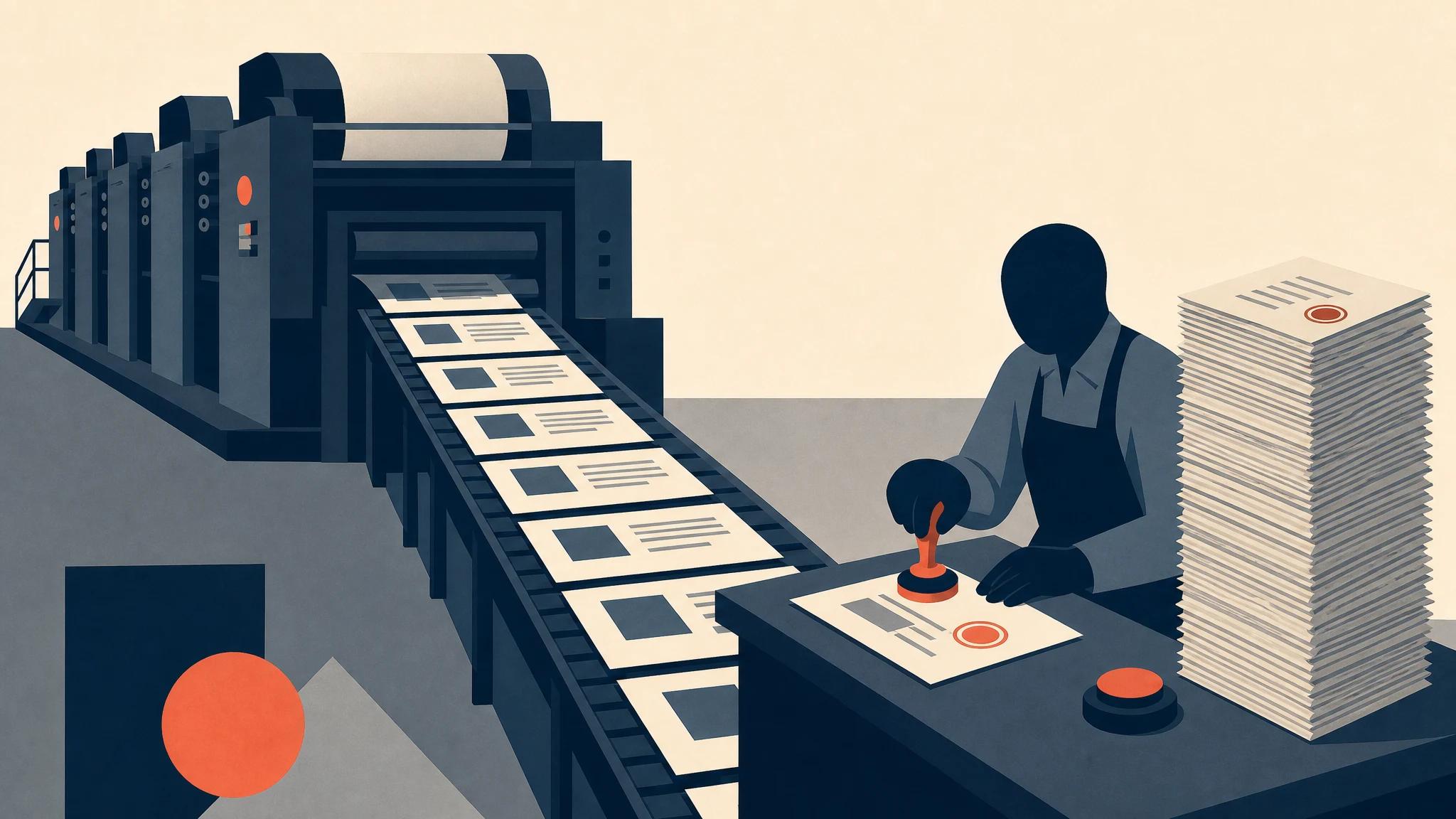
What once took an entire afternoon — gathering materials, polishing sentences, writing a single column — has been compressed to seconds. One prompt produces hundreds of smooth, fluent pieces. Marketing teams cheer, and the unit price of content craters. Everyone calls this efficiency.
But efficiency always reduces one cost while shifting another somewhere else. Generation costs have converged toward zero. So where did the vanished cost go? It went to the reader. More precisely, it migrated to the time and mental energy of anyone who wants to verify whether a piece of writing was genuinely authored by a responsible human being.
This is where the asymmetry emerges. The cost of producing plausible falsehoods has nearly disappeared, while the cost of exposing them as false — or proving something is authentic — has actually risen. Brandolini's Law, that old rule of thumb holding that refuting nonsense takes far more energy than inventing it, has now been automated at industrial scale. The real bill falls not on the fake, but on the labor of proving the real.
Who Gets Billed for the Verification Tax?
This tax is not collected equally. When a patient arrives with an AI-generated summary and pushes back, the time a doctor spends correcting those errors line by line never appears on the invoice. Teachers spend more time sorting out whether a student assignment was written by hand than actually grading it. Journalists push back deadlines verifying whether a tip video was synthetically generated. HR managers comb through AI-inflated résumés to find actual people.
The cost is borne not by those who generated the content, but by those who received it. The producer creates the externality; society cleans up afterward. It is the same structure as a factory discharging wastewater into a river while residents downstream pay for water purification. The difference is that this time, nearly every information consumer lives downstream.
In this context, sources, bylines, and publisher accountability have suddenly become scarce goods. In an ocean of infinitely replicable text, what holds value is no longer the writing itself, but the someone behind it willing to put their name on it and bear responsibility if proven wrong. We are crossing into an economy where verifiability is an asset.
Platforms Shift the Cost Again
Platforms now occupy the position of designing who pays this tax — and who is exempted. Search engines and social feeds place AI-generated content in the same row as human writing, pushing the burden of determining authenticity onto individual users. The power to attach verification badges or source labels rests with platforms, yet their criteria are never disclosed. The power to decide whose writing receives a trust label is itself the new power.
The training-data side is even more brazen. High-quality, human-verified text — news articles, academic papers, encyclopedias — produced at great cost is vacuumed up as fuel for models. The labor that created that data is never priced. Verified originals are mined for free and become the raw material for machines that generate unverified imitations in infinite quantity. Real inventory shrinks as fake production grows. Model collapse — in which models retrain on their own outputs — is merely the technical name attached to this depletion.
There are counterarguments. If AI will also automate verification, why emphasize only human costs? That is a fair point. Fact-checking assistance tools are genuinely useful. But detectors and generators are locked in the same arms race, and at the end, the party putting their name on the line and accepting responsibility is not a machine. Automated verification can lighten the burden, but it cannot stand in for accountability. Responsibility cannot be delegated.
Better Design, and Korea's Rules
This is not an argument for stopping technology. It is an argument for redesigning who pays the verification tax. The principle is simple: make those who create the cost bear the cost.
Generated content must carry its source and method of production. Technologies such as AI-involvement disclosures and content-provenance standards already exist. The problem is political will. Korea's AI Basic Act has pointed in the direction of mandating disclosure of AI-generated content, but if those disclosures remain mere formalities, they become pardons rather than obligations. The rules must specify who verifies the disclosures and who is held responsible for omissions. Platforms must be required to publish the criteria behind their trust labels and be held accountable for those judgments. For training data, pathways must exist to compensate verified sources.
Consider a local media outlet in Busan. In an era when AI can produce article drafts ten times faster, the outlet that survives is not the one that produces the most — it is the one that gets the fewest things wrong. Paradoxically, the better a newsroom uses AI, the greater the weight placed on the human editor. The more machines take over production, the higher the value of that last person willing to put their name on it and take responsibility if wrong. This is where a self-referential logic takes hold: AI-native media actually reinforces the human publisher.
Technology does not make trust cheap. What remains is deciding who gets billed for the cost of proving it. The question is not whether to use this technology — it is whose rules it will run under.
This article was automatically translated from the Korean original by AI. For the authoritative version, read it in Korean.
한국어 원문 읽기 →