GPUs Bypass Busan
AI computation infrastructure flowing to the Seoul metropolitan area and abroad is not a technical problem. It is a question of who can translate the physical bottlenecks of power, cooling, and submarine cables into the language of policy. What blocks Busan's dormant assets is not technology — it is the absence of a language to name them.
AI Summary
Busan possesses rare natural advantages for AI data center development — proximity to southeastern power generation, port land suited for seawater cooling, and submarine cable landings that serve as Korea's physical gateway to Japan and the United States. Yet compute investment continues to bypass the city because no institutional framework brings together power authorities, port agencies, telecom regulators, and local governments around a unified AI compute location policy. Until Korea builds the shared public language to recognize compute infrastructure as strategic national capital, its negotiating position in the global AI economy will remain structurally weak.
People Believe AI Is Software
Enter a sentence into a chatbox and an answer comes back. This leads many people to think of AI as an immaterial service floating somewhere in the cloud — something intangible, with no physical footprint to speak of. This is precisely where the most dangerous misconception begins.
Behind every response a generative model produces, tens of thousands of GPUs are simultaneously running at full heat. GPUs consume electricity and exhaust heat. The power drawn by a single data center building rivals that of a mid-sized steel mill, and a substantial portion of that energy converts directly into heat, demanding enormous quantities of cooling water. Before AI is code, it is civil engineering, electricity, and water resources. Computation must land somewhere, and what determines where it lands is not an algorithm — it is the power grid, water supply, and cable infrastructure.
Compute Location Is an Equation Solved by Three Bottlenecks
Real estate prices don't determine where data centers get built. Three factors do. First: power — grid connection slots capable of delivering stable, affordable, high-volume electricity on demand. Second: cooling — water to shed heat, or cold seawater and outside air. Third: data pathways — submarine cable landings and backbone networks capable of carrying model weights and inference traffic without latency.
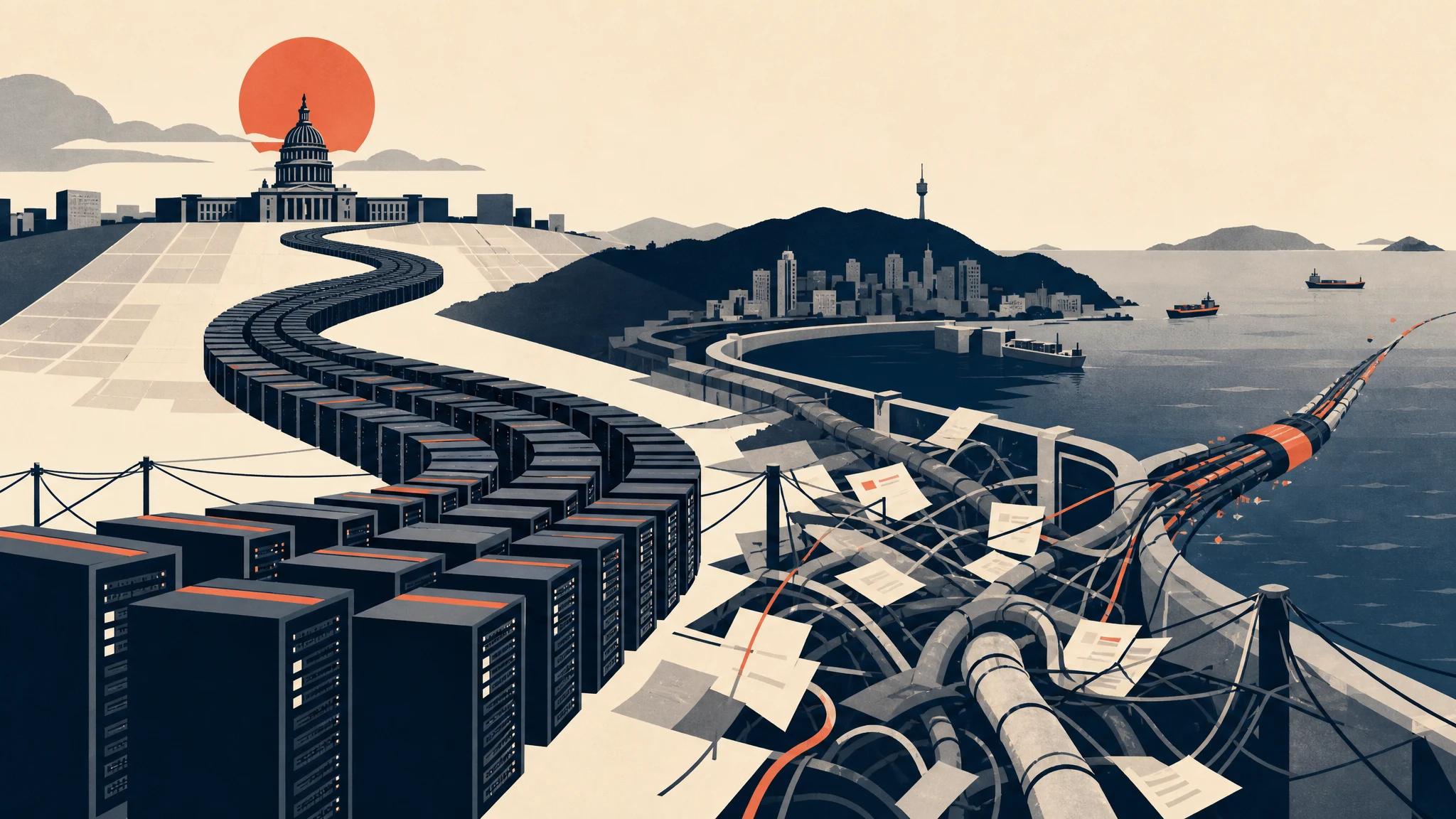
Few cities in Korea can thread all three together. Busan is one of the rare candidates. It sits adjacent to the southeastern power production belt where nuclear and LNG generation is concentrated. It has port land capable of drawing cold seawater for cooling. And the majority of international submarine cables entering Korea make landfall around Busan's Songjeong district and the Geoje area. This is the physical gateway through which Korea's data flows to Japan and the United States.
As an analogy, Busan in the AI era is a port that receives data instead of container ships. But while the port exists, there is no commitment regarding who will build and operate the docks. The grid slots, the cables, the land — all of it is there. What hasn't existed is any actor who has bundled these into a single asset called 'AI compute location.'
Using GPT Well as an Individual and Understanding Compute as a Nation Are Different Things
When AI is seen solely as a personal productivity tool, none of this is visible. You can search for how to write better prompts, but no one asks which country's power grid processes those prompts. Depending on overseas data centers for computation means outsourcing both cost control over inference and data sovereignty at the same time. No matter how high individual proficiency rises, if society doesn't understand where that computation runs and under whose rules, no negotiating leverage ever develops.
A strong counterargument presents itself here: computation can be rented from the cloud from anywhere, so isn't building GPUs on domestic soil inefficient? True — but only half true. Renting is cheaper in peacetime. But when compute resources become strategic goods — as with semiconductor export controls — having a physical base of computation of meaningful scale on your own national grid changes your position at the negotiating table. Efficiency is the language of peacetime. Location is the language of crisis. A country needs to speak both.
The Institutional Blanks Korea Has Yet to Fill
The problem lies not in technology but in institutional gaps. Power grid access falls under KEPCO and the Ministry of Trade, Industry and Energy. Port land falls under the Ministry of Oceans and Fisheries and port authorities. Submarine cable landings fall under the Ministry of Science and ICT and telecommunications carriers. Data center location regulations fall under local governments. Nowhere in public administration do all four of these parties sit at the same table to evaluate 'AI compute location' as a unified national asset.
There is no common framework language for how AI data center demand should factor into power grid impact assessments, for who assigns security value to submarine cable landing zones, or for what communities receive in return for hosting compute facilities that consume their power and water. Distributed location incentives to counter Seoul-area concentration have not been designed. Mechanisms to channel regional compute into regional industry and research have not been built. These blanks are not only Busan's loss. Without a framework, every negotiation begins on terms set by global operators.
A Nation That Truly Understands Rather Than One That Simply Uses Well
Compute is not immaterial. It rests on the most physical of foundations — electricity, water, and cables — and how a country reads those foundations and arranges them within institutions determines its digital operational capability. The reason GPUs bypass Busan is not that the assets are absent. It is that no shared public language exists to bundle those assets together.
The country that uses AI most skillfully is not automatically the strongest. The strong country is one in which society collectively understands what this technology consumes, where it lands, and under whose rules it runs. Korea has not yet arrived at that social understanding. Busan's empty docks are the clearest evidence of that failure to comprehend.
This article was automatically translated from the Korean original by AI. For the authoritative version, read it in Korean.
한국어 원문 읽기 →