The Place Where Veto Power Was Handed Over
The real power of automation lies not in 'do' but in 'don't.' The moment a human presses the final button as a rubber stamp, accountability belongs to no one.
AI Summary
This essay argues that what automation takes from humans is not physical labor but the veto — the capacity to stop, refuse, and bear responsibility when a system errs. As AI accuracy rises, the human at the end of the pipeline shrinks from decision-maker to rubber stamp, and accountability disperses until it effectively evaporates. The author calls on Korea, a global automation leader, to design not just efficient systems but protected institutional space for refusal, where humans can say 'no' without penalty.
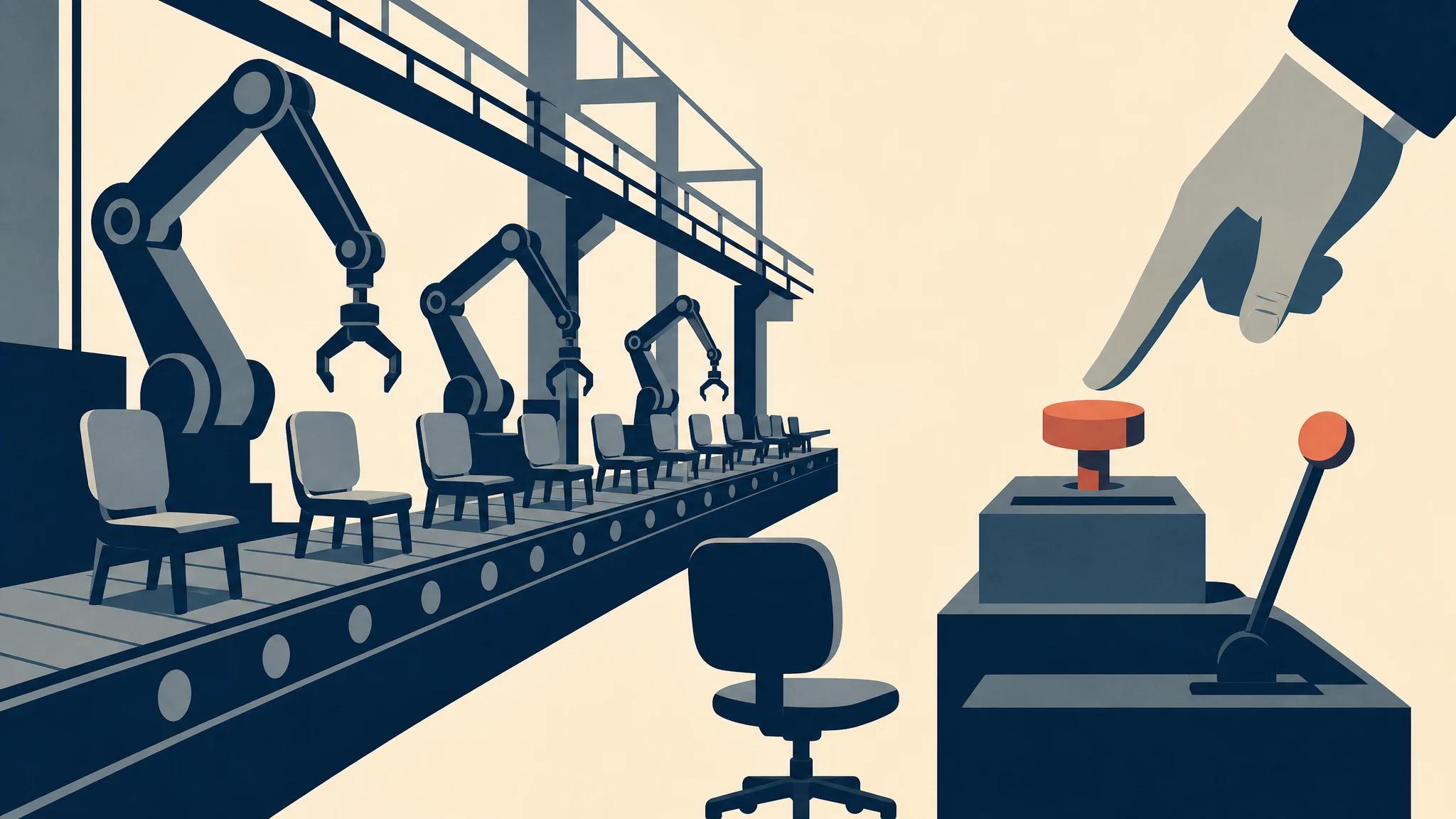
Imagine a scene in a hospital emergency room. An AI image-reading system has classified a pulmonary nodule as normal, and the on-call physician, at three in the morning, passes that reading with a single press of the confirm button. Did the doctor make a decision — or did he simply let through a decision already made? We tend to understand automation as 'machines doing the work.' But what this scene reveals is something different. What the machine did was not execution: it was a suspension of judgment. It sent a signal on the doctor's behalf — no need to look further, it's fine to stop here.
One ability humans have long believed was their own is the power to stop: feeling that something is wrong and stepping back; refusing even when all the rules check out. We have vaguely believed that execution is done by muscle, but refusal is done by conscience. Yet what automated systems are taking from humans today is not the right to execute but precisely this right to refuse — the veto.
What Automation Takes Is Not Your Hands, But Your Brakes
| First-generation industrial automation | Today's artificial intelligence | |
|---|---|---|
| What is being replaced | Human hands (welding, assembly, transport) | The human brake — veto power |
| What remains for humans | Final veto authority | Signing a pre-filled answer sheet |
The first generation of industrial automation replaced human hands — welding, assembly, transport. The role left for humans was clear: make the judgments machines could not, and stop the line when something seemed off. Humans remained the final vetoers.
Today's AI does not target the hands; it targets that braking mechanism. Content recommendation decides what you see. Credit models decide whose loan application is rejected. Hiring filters decide which résumés advance to the next round. Humans sit at the end of this flow, but what they receive is not a blank page — it is an answer sheet already filled in. Their role is not to write but to sign.
Here a subtle inversion occurs. When the system says 'yes,' the human who tries to say 'no' must furnish active grounds and energy — and must personally absorb the consequences of overriding the system. Simply rubber-stamping, on the other hand, costs nothing. Refusal carries a price; endorsement does not. Default bias and automation trust, as cognitive science terms them, converge at precisely this point. People are wired to follow a pre-presented answer rather than overturn it. And so, without ever having been formally handed over, the veto quietly ceases to function.
When the Final Button Shifts from Decision to Ratification
Framing the problem purely as a question of AI accuracy leads you astray. Even if a model is right 99 percent of the time — or precisely because it is — human veto power atrophies faster. Facing a system that is almost always correct, the human who raises a question every single time becomes the inefficient one, the one who slows everything down. Organizations do not reward that person. The higher the accuracy, the more exercising the right to stop looks like a rude, irrational act.
And the structure of accountability begins to come apart. Say an accident occurs. The model developer says: 'The final judgment was made by a human.' The human operator says: 'We were trained to trust the system.' Both are half right. The human formally pressed the button, so he wears the shell of responsibility — but in practice he was stripped of any real conditions for refusal and only ratified. The law looks for the hand that pressed the button, but the ethically meaningful decision was not in that hand. Accountability does not disappear — what disappears is the point at which accountability can be assigned. To say it was 'distributed' is a polite formulation; more precisely, it evaporates.
A strong counterargument exists. Was human veto power ever that sacred? Human judges and human physicians were also subject to bias, fatigue, and mood. Would it not be more just to hand decisions over to a consistent machine and remove the human from the loop? There is merit in this. But the counterargument misses the essential point. What we are trying to preserve is not the superiority of human judgment but the fact that there is actually someone inside the system who can halt things when they go wrong and be held accountable. A machine may be more accurate, but it does not feel shame and does not resign. Veto power is not a question of accuracy; it is a question of whether a responsible subject exists.
What Korea Must Design Is Not Automation, But the Space for Refusal
Korea is a society at the forefront of automation adoption. Its industrial robot density ranks among the highest in the world, and algorithmic decision-making in public administration and finance is expanding rapidly. Busan's smart-port automated cranes move containers faster and more accurately than any human crew. Yet the automation conversation almost always stays within the bounds of 'how quickly and how extensively can we replace.' Rarely asked is who can stop things, and under what conditions.
The redefinition of education and labor diverges at exactly this point. In an era of externalized intelligence, an education designed to make humans smarter is already a losing battle in an accuracy contest with machines. What remains for education is cultivating people who know when to stop: the instinct to say 'this isn't right' even when a system's answer is formally correct, and the professional ethics to bear the cost of that refusal. Organizations must build structures that do not punish those who refuse; institutions must create liability rules that distinguish ratification from genuine decision-making. In an automated system, what truly needs to be designed is not model performance but the conditions under which humans can actually exercise their veto. A switch that nominally exists to turn things off, and a switch that a person can turn off without incurring any penalty, are entirely different matters.
To delegate veto power is ultimately to delegate responsibility. But machines are entities incapable of receiving responsibility. Responsibility dispatched to a place that cannot receive it never arrives — it scatters in the void. The question, then, must be reframed: In the age of artificial intelligence, what humans must preserve is neither the capacity to execute more nor the capacity to judge more accurately. It is keeping a place for stopping inside the human — not erasing from the system the person who can feel shame when something goes wrong and can be held accountable. What shall we leave as human work? Perhaps the answer is this: the right to say 'no' at the very last moment must remain, to the end, on the human side.
This article was automatically translated from the Korean original by AI. For the authoritative version, read it in Korean.
한국어 원문 읽기 →