When Inference Becomes Free
In Silicon Valley, the per-call cost of a model is being cut in half every quarter. This is not news about things getting cheaper. It is a signal that as prices approach zero, money is leaving the model and migrating to workflows, data, and trust. The question is: what will Korean SaaS build on top of the model?
AI Summary
As AI inference costs plummet toward zero, value is migrating away from models toward adjacent layers — proprietary data, workflow ownership, and trust certification. Silicon Valley's capital deployment already reflects this shift, with major players using cheap inference as a loss leader to capture workflow entry points. Korean SaaS companies that treat falling costs as merely a savings opportunity — without building defensible layers atop the model — risk being displaced the moment model providers move down the stack.
The Speed at Which Pricing Collapses
Over the past year and a half, the cost of a single call to a comparable-quality model has continued to slide. OpenAI has driven token prices down to a fraction of what GPT-4 once cost; Google has drawn the same curve with Gemini Flash, and Anthropic with Haiku. The open-source world has followed suit. With Meta's Llama, DeepSeek, and Mistral releasing their weights, the marginal cost of running inference yourself has dropped to something close to an electricity bill.
The industry reads this as "AI has finally gotten cheap." That's half right — but the other half misses the point.
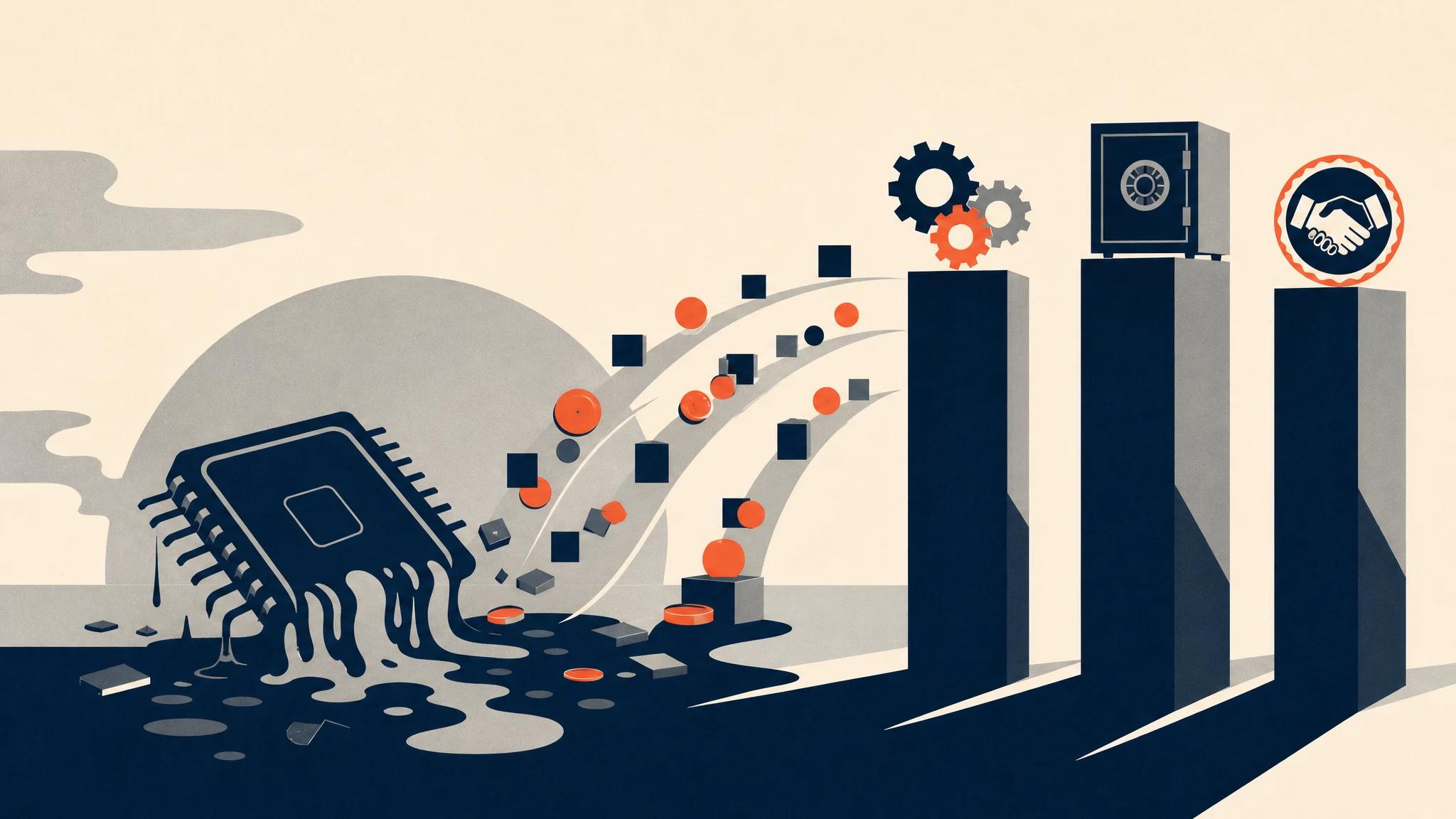
The falling price is not the news. How far it falls is. Resources whose marginal costs converge toward zero have always done the same thing throughout history: value drains out of that resource and migrates to the adjacent, scarce layer. When bandwidth became free, money moved to search and platforms. When storage became free, money moved to data itself. When inference becomes free, models lose their margin — and whatever is stacked on top of them captures it instead.
The Model Has Already Lost — Only the Winner Is Left to Determine
Look at how capital is being deployed in Silicon Valley and the answer is already apparent. OpenAI is doubling down on ChatGPT as a workflow entry point and enterprise contracts — not a picture of making money from the model itself, but of using the model as bait to embed itself inside users' work streams. Anthropic has lodged Claude in the layer where "agents actually finish the job" — code and computer operation. Microsoft hides the model inside the Office workflow via Copilot. Users are not calling a model; they are delegating work.
The pattern is clear: no one is selling "the model itself" as the final product.
The direction of VC money is even more explicit. Since 2024, the center of gravity in early-stage rounds has shifted from foundation models to applications and agent infrastructure. Coding workflow Cursor, legal workflow Harvey, and enterprise data search Glean have all raised large rounds. None of them build models. They borrow others' models but hold onto what the model cannot touch: the workflow, the proprietary internal data, and the trust in the output.
A counterargument is possible: if models keep getting smarter, won't they swallow the workflow layer whole? The worry is that once agents handle everything on their own, it doesn't matter what you build on top. There is something to that. But the direction runs backward. The smarter the model, the more differentiation is pushed outside it. If anyone can call the same level of reasoning at near-zero cost, the remaining moat is only what you feed that reasoning (data), the sequence in which you put it to work (workflow), and who is accountable for the output (trust). A smarter, commoditized model does not eliminate the moat — it relocates it.
Capital Flows to the Layer Above Tokens, Not the Tokens Themselves
Infrastructure investment points in the same direction. Big tech is pouring hundreds of billions of dollars into GPUs and data centers — not to sell tokens cheaply, but to make tokens cheap enough to capture the workflows running on top. Pushing inference costs toward zero is not charity; it is loss-leader pricing designed to pull everyone onto their platform. It resembles how carriers once handed out free handsets and recovered the margin through service plans.
So what is truly expensive in Silicon Valley right now is not tokens. It is proprietary data locked to a specific domain, an entry point that has captured users' actual workflows, and the trust certification that says "this answer can be relied upon." As inference becomes free, these three things appreciate in value. The value of the layer above rises in precise proportion to the decline in unit-cost curves.
Korean SaaS: Supplier, Customer, or Standard-Setter?
This is where we need to locate Korean companies on the map. Suppose a SaaS team in Busan builds a product by calling GPT or Claude via API. Inference costs being cut in half every quarter is, in the short term, good news for that team — lower input costs. But the same tailwind lands on every competitor equally. A product that runs on model calls alone loses differentiation at exactly the same rate that prices fall. In a world where anyone can call the same model even more cheaply, a SaaS product that has built nothing on top of the model soon becomes a thin shell wrapping a zero-cost feature.
To protect margin, you need to build a layer that does not disappear even when the model becomes free. One is data: a structure that accumulates domain-specific data inside the product — data customers cannot take with them when they leave. The next is workflow: not one-off answers, but a flow in which a customer's work is completed from start to finish inside the tool. The last is trust: verification, sourcing, and lines of accountability aligned with Korean regulations and industry context. In high-stakes domains such as healthcare, law, and finance — where being wrong is expensive — this trust layer becomes the price tag.
On the question of whether you are a supplier, a customer, or a standard-setter, most Korean SaaS companies currently occupy the customer position — buying someone else's model. That is not a bad place to be. But remaining only a customer means you are entirely replaceable the moment the model company moves down into the workflow layer. If OpenAI begins attaching industry-specific workflows directly inside ChatGPT, the thin wrappers profiting on top of it will be the first to be swept away.
The Invoice for Waiting and Watching
If you read the trend of inference costs falling toward zero as simply "great, costs are down," that very sense of relief is what damages your cost structure next quarter. Prices have fallen, and differentiation has fallen with them — but you will still be selling the same product without having noticed. Staying planted at the model layer while Silicon Valley moves its capital to the layer above it: that is the true cost of waiting and watching.
Silicon Valley news is not someone else's story. The moment inference becomes free is the settlement day that reveals whether Korean SaaS has stacked data, workflow, and trust on top of models — or has nothing to show.
This article was automatically translated from the Korean original by AI. For the authoritative version, read it in Korean.
한국어 원문 읽기 →